How the Instagram Algorithm Works in 2026: What Creators Need to Know
How Instagram's 4 algorithms work in 2026. Deep dive into Feed, Stories, Reels, and Explore ranking signals with actionable optimization strategies for each surface.
FlowShorts Team
Instagram doesn't have one algorithm. It has four separate ranking systems — one each for Feed, Stories, Reels, and Explore. Each uses different signals, prioritizes different behaviors, and rewards different content strategies. Understanding how each one works is the difference between posting into the void and consistently reaching new audiences.
This guide breaks down every ranking system, the signals that matter most, and exactly what to do with that knowledge.
The Four Instagram Algorithms
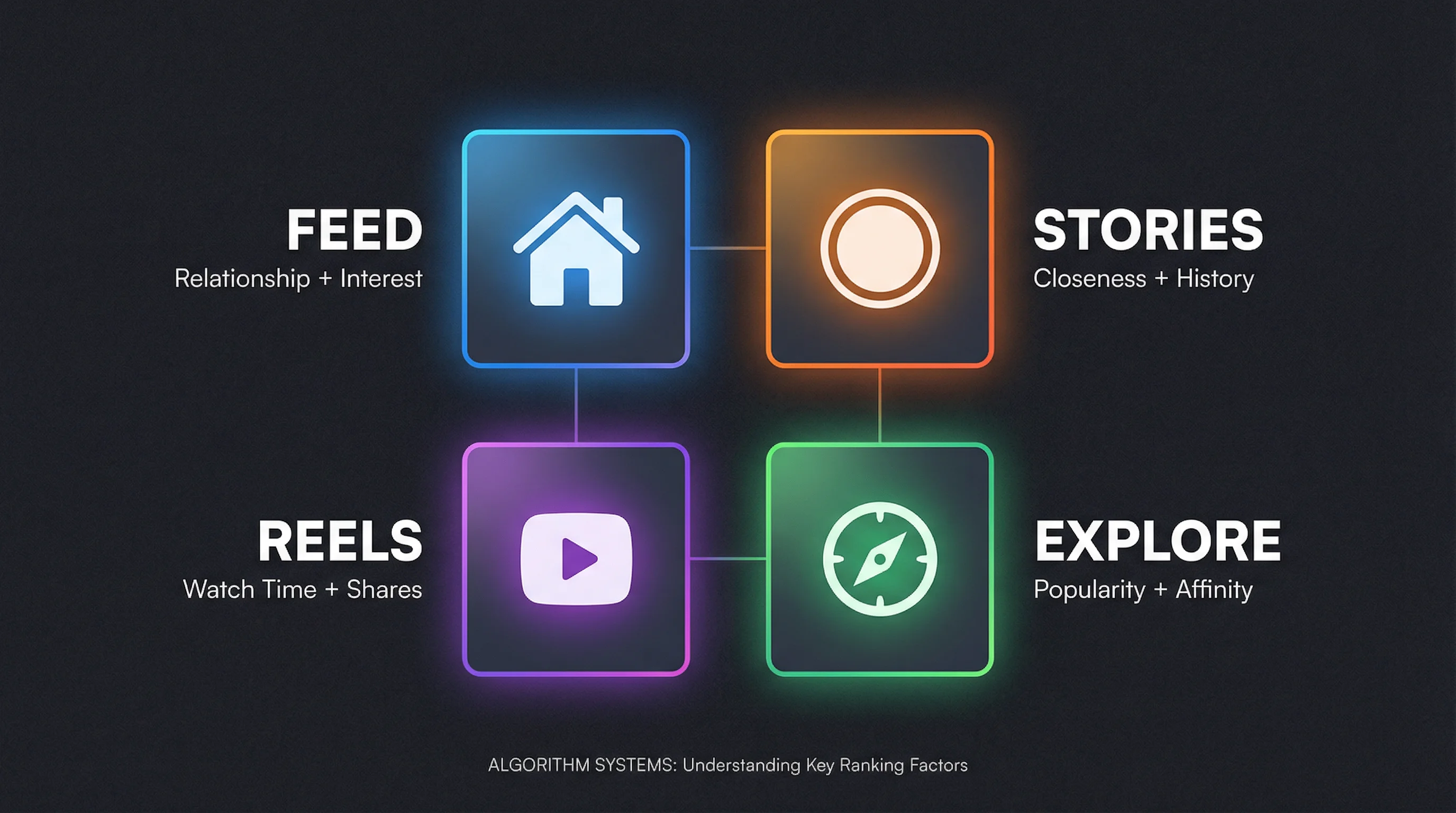
1. Feed Algorithm
The Feed shows content from accounts you follow, mixed with recommended posts from accounts you don't. Instagram ranks Feed content based on:
| Signal | Weight | What It Means |
|---|---|---|
| Relationship | Highest | How often you interact with this account (likes, comments, DMs, profile visits) |
| Interest prediction | High | How likely you are to engage based on past behavior with similar content |
| Recency | Medium | Newer posts ranked higher than older ones |
| Session frequency | Medium | Users who open Instagram less see a "best of" Feed; frequent users see chronological-ish |
| Following count | Low | Users who follow many accounts see less from each individual account |
What this means for creators: Your Feed posts primarily reach people who already follow you and actively engage with your content. To stay in followers' Feeds, you need consistent interaction — not just posting, but engaging with their content too. DM conversations are the strongest relationship signal.
2. Stories Algorithm
Stories are ranked by how close Instagram thinks you are to each account. The order of Stories in your tray isn't random — it's sorted by predicted interaction likelihood.
| Signal | Weight | What It Means |
|---|---|---|
| Viewing history | Highest | How consistently you watch this account's Stories |
| Engagement history | High | Replies, reactions, sticker taps on their Stories |
| Closeness | High | DM frequency, mutual interactions, tagged together |
| Recency | Medium | Newer Stories appear first within close accounts |
What this means for creators: Stories are a retention tool, not a discovery tool. They only show to followers. To stay at the front of the Stories tray, use interactive stickers (polls, quizzes, questions) that drive replies — each reply strengthens the relationship signal.
3. Reels Algorithm
The Reels algorithm is your primary growth engine. It's designed to surface entertaining content from accounts you don't follow — making it the best format for reaching new audiences.
| Signal | Weight | What It Means |
|---|---|---|
| Watch time / completion rate | Highest | Percentage of the Reel watched. Full watches + replays are strongest. |
| Engagement velocity | High | Likes, comments, shares, saves in the first 30-60 minutes |
| Shares (sends) | High | DM shares are weighted heavily — signals "worth showing to friends" |
| Audio trending | Medium | Reels using trending audio get boosted distribution |
| Account history | Medium | Accounts with consistent posting and engagement get more distribution |
| Content originality | Medium | Reposted or watermarked content (e.g., TikTok logo) gets deprioritized |
What this means for creators: Optimize for completion rate above all else. Short Reels (15-30 seconds) with a hook in the first second and a loop at the end maximize this signal. Trending audio gives an additional boost. Shares are the most underrated signal — create content people want to send to friends.
For detailed Reels strategy, see our guides on how to make Reels and Reels dimensions.
4. Explore Algorithm
Explore is designed to help users discover new content from accounts they don't follow. It's entirely algorithmic — no chronological element.
| Signal | Weight | What It Means |
|---|---|---|
| Post popularity | Highest | Engagement rate relative to impressions — fast, high engagement signals Explore-worthy |
| User's activity history | High | What the user has liked, saved, shared, and searched for recently |
| Topic affinity | High | How closely the content matches the user's demonstrated interests |
| Creator authority | Medium | Accounts that consistently produce engaging content in a niche get prioritized |
What this means for creators: You can't directly "get on Explore." It happens when your content's engagement rate is unusually high relative to its impressions. Fast initial engagement (first 30-60 minutes) is the trigger. Post when your audience is active, engage in comments immediately, and create content that drives saves and shares.
How the Algorithm Evaluates New Content
Let AI Handle Your Posting Schedule
FlowShorts auto-posts videos at the optimal time to YouTube Shorts, TikTok & Instagram Reels.
Set Up Auto-Posting →When you publish a new post or Reel, Instagram follows this process:
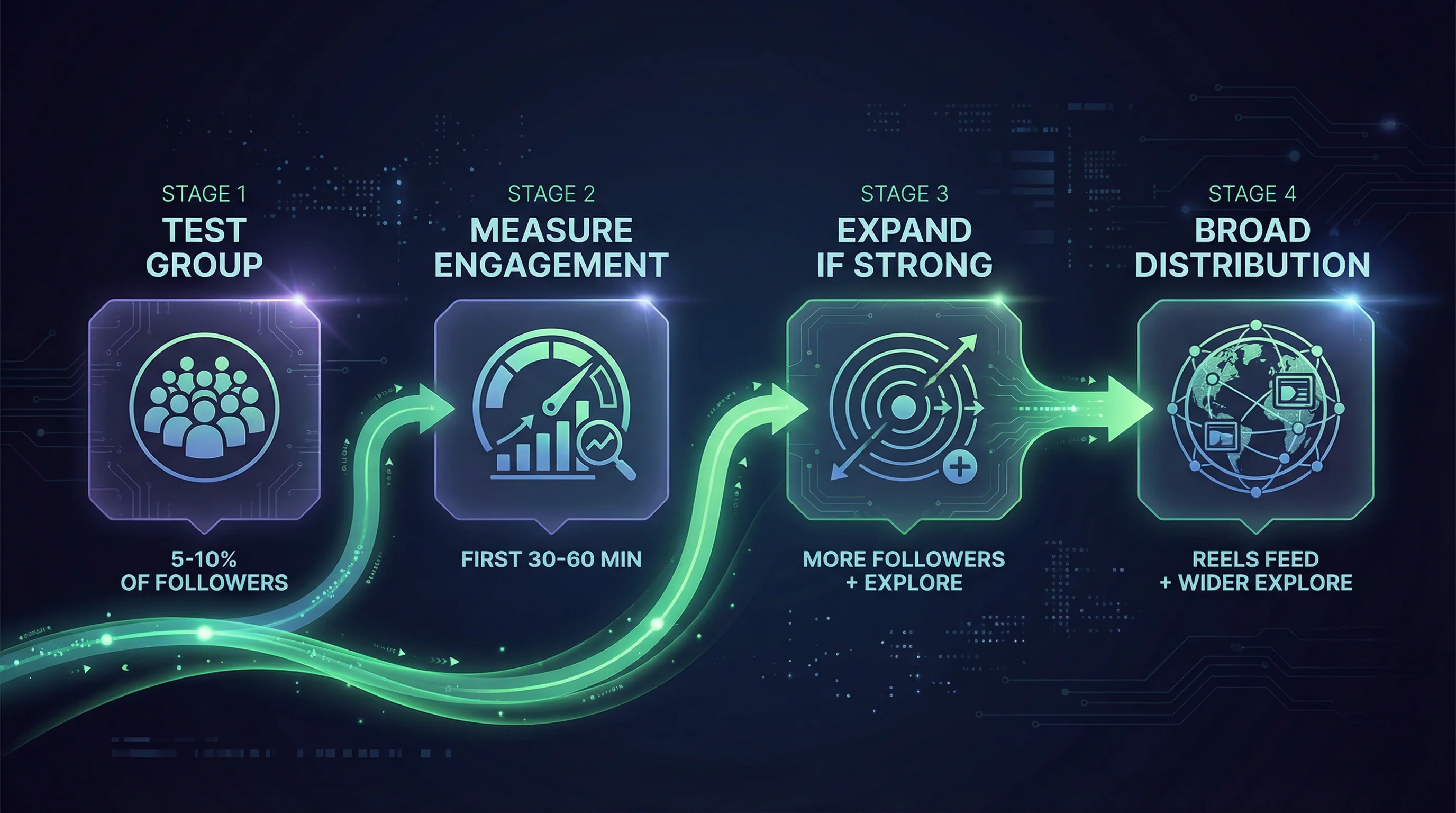
- Small test audience: Instagram shows your content to a small percentage of your followers (and, for Reels, a small non-follower test group)
- Engagement measurement: The algorithm measures engagement rate, watch time, saves, shares, and comments in the first 30-60 minutes
- Distribution decision: If engagement exceeds the threshold for your account size, Instagram expands distribution — more followers, then Explore, then broader Reels feed
- Continued evaluation: Distribution continues expanding as long as engagement signals stay strong. It slows when engagement rate drops (which naturally happens as the audience becomes less targeted)
This is why the first hour after posting matters so much. Fast, genuine engagement in that window determines whether your content reaches 500 people or 50,000.
What the Algorithm Deprioritizes
Instagram has been explicit about content that gets reduced distribution:
- Reposted content from other platforms — Especially with visible watermarks (TikTok logo). Instagram wants original content, not reposts.
- Low-resolution or blurry video — Upload at 1080×1920 minimum. See our Reels size guide.
- Borderline content — Content that doesn't violate guidelines but approaches the line (violent, sexually suggestive, misleading) gets reduced Explore and Reels distribution.
- Engagement bait — "Like if you agree," "Comment YES for a surprise." Instagram explicitly downgrades engagement bait. Ask genuine questions instead.
- Content with excessive text overlays — Covering more than 50% of the image/video with text can trigger reduced distribution in some placements.
- Inactive accounts — Accounts that post sporadically get lower priority than consistent posters.
Algorithm Optimization by Content Format
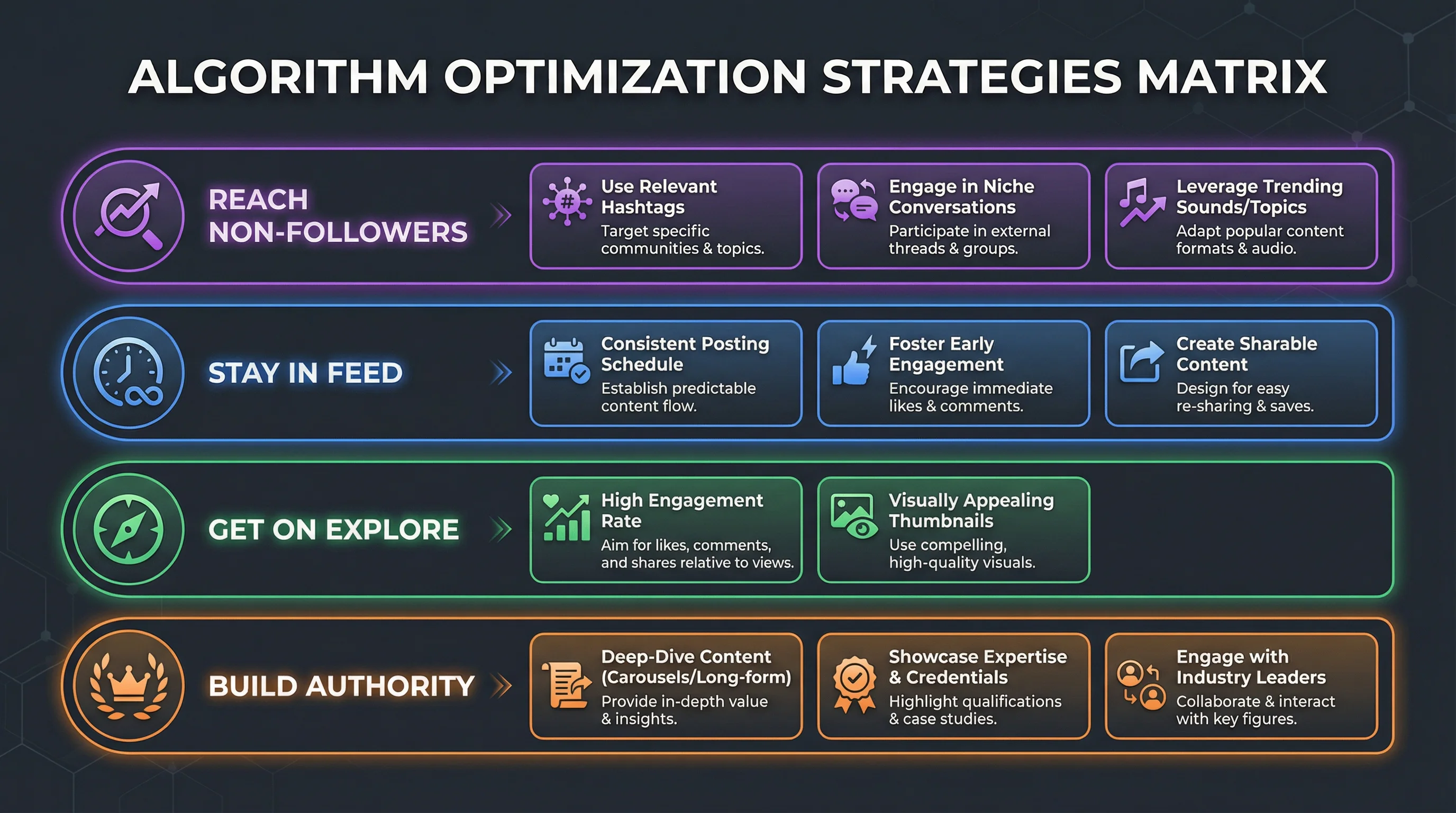
| If You Want To... | Optimize This | Actionable Tactic |
|---|---|---|
| Reach non-followers | Reels completion rate + shares | 15-30s Reels with hooks, trending audio, loop endings |
| Stay in followers' Feeds | Relationship signals | Reply to comments, send DMs, engage with their content |
| Get on Explore | Engagement velocity | Post at peak times, engage in first 30 min, create save-worthy content |
| Stay top of Stories tray | Story interaction rate | Use polls/quizzes/questions — every reply strengthens your position |
| Build topical authority | Niche consistency | Stay on-topic so the algorithm confidently classifies and recommends you |
Common Algorithm Myths (Debunked)
Myth: "The algorithm is hiding my content"
Reality: The algorithm distributes content based on engagement signals. If reach is low, the content isn't generating enough engagement to trigger wider distribution. The fix is better hooks, tighter pacing, and more engaging content — not fighting the algorithm.
Myth: "Posting at the wrong time kills reach"
Reality: Posting time matters for the first-hour engagement window, but a great piece of content posted at a suboptimal time still outperforms mediocre content posted at the "perfect" time. Timing is optimization, not make-or-break. See our best time to post Reels for data.
Myth: "You need 30 hashtags for maximum reach"
Reality: Instagram's own team has said 3-5 relevant hashtags outperform 30 generic ones. Hashtags help classify your content topically — they're not a distribution hack. Quality and relevance over quantity.
Myth: "Editing your caption after posting hurts reach"
Reality: No evidence supports this. Instagram has explicitly denied that caption edits affect distribution. Edit away if you spot a typo.
Myth: "Business accounts get less reach than personal"
Reality: Instagram has denied this repeatedly. Business accounts have the same algorithmic treatment. The difference is that business accounts see analytics and can run ads — neither of which reduces organic reach.
How to Reset a Broken Algorithm
Let AI Handle Your Posting Schedule
FlowShorts auto-posts videos at the optimal time to YouTube Shorts, TikTok & Instagram Reels.
Set Up Auto-Posting →If your reach has dropped significantly and your content is reaching fewer people than usual, your algorithmic profile may need a reset. This involves clearing behavioral signals and retraining the algorithm with new engagement patterns.
We wrote a complete step-by-step guide for this: how to reset your Instagram algorithm.
The Algorithm Rewards Consistency Above All
Every algorithm signal improves with consistent posting:
- Completion rate improves as you learn what hooks and formats your audience responds to
- Engagement velocity improves as your active follower base grows
- Account authority improves as Instagram classifies you as a reliable content source in your niche
- Relationship signals improve as you build habitual engagement with your community
Consistency is the compound interest of social media. Posting 5 Reels per week for 6 months produces dramatically better results than posting 20 Reels in one week then disappearing.
For sustainable daily Reels posting, FlowShorts auto-posts Reels on a schedule — AI-generated content published daily without manual production. See our full Instagram marketing strategy for the complete playbook.
Frequently Asked Questions
How does the Instagram algorithm work in 2026?
Instagram uses four separate algorithms for Feed, Stories, Reels, and Explore. Feed prioritizes relationship signals (who you interact with). Stories prioritize viewing history and closeness. Reels prioritize watch time, completion rate, and shares. Explore prioritizes post popularity and topic affinity. Each system evaluates different signals to rank content.
What is the most important algorithm signal for Reels?
Completion rate — the percentage of viewers who watch your Reel to the end. Full watches and replays are the strongest signals. This is why shorter Reels (15-30 seconds) typically get wider distribution than longer ones — they have higher completion rates.
Does the algorithm favor certain account types?
No. Instagram has explicitly stated that personal, creator, and business accounts receive the same algorithmic treatment. The algorithm favors content quality and engagement, not account type.
Why did my Instagram reach drop suddenly?
Common causes: a recent post underperformed (reducing algorithmic confidence), inconsistent posting after a period of activity, content shifted away from your established niche (confusing the algorithm), or Instagram is testing algorithm updates. Solution: return to consistent posting in your niche and focus on engagement quality.
Do hashtags affect the algorithm?
Hashtags help Instagram classify your content topically, which improves recommendation accuracy. They're not a direct ranking signal — the algorithm doesn't boost posts because they have hashtags. Use 3-5 highly relevant hashtags to help the algorithm understand your content.
How often should I post to stay in the algorithm?
Reels: 5-7 per week. Feed/carousels: 2-3 per week. Stories: 3-5 per day. Consistency matters more than volume. A sustained posting schedule builds algorithmic momentum; sporadic posting loses it.
Related Guides
- How to Reset Your Instagram Algorithm
- Instagram Marketing Strategy: Complete Playbook
- How to Get More Instagram Followers
- How to Make Instagram Reels
- Best Time to Post Reels
- Instagram Reels Size & Dimensions
Work With the Algorithm, Not Against It
The algorithm rewards consistency. FlowShorts generates AI-powered Reels and auto-posts daily to Instagram, YouTube Shorts, and TikTok — keeping your content flowing and your algorithmic momentum building.