Faceless TikTok vs Faceless YouTube: Where Should You Start? (2026)
An honest comparison of faceless TikTok vs faceless YouTube for creators starting in 2026. Covers growth speed, monetization paths, algorithm differences, content requirements, and the smart strategy for each platform.
FlowShorts Team
You''ve decided to create faceless content. Smart move. No camera, no face, no personal brand risk. But now comes the real question: should you start on TikTok or YouTube?
Both platforms work incredibly well for faceless creators. TikTok can hand you an audience overnight. YouTube can pay your rent. But they reward different things, and choosing the wrong starting point can cost you months of wasted effort.
This guide compares faceless TikTok and faceless YouTube side by side — growth speed, monetization, algorithms, content requirements — so you can make the right call for your situation. If you''re brand new to the faceless TikTok space, start with our complete guide on how to start a faceless TikTok channel first.
The Quick Answer
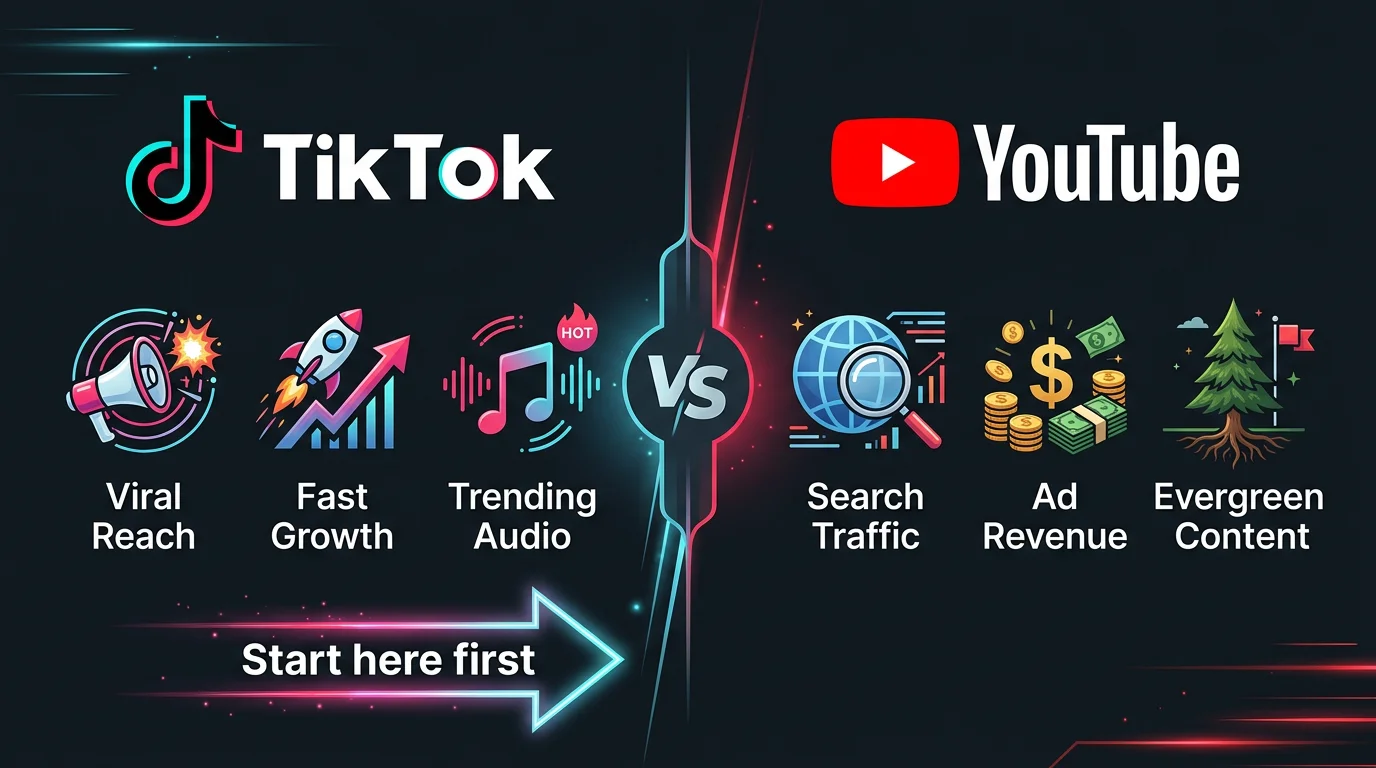
Start with TikTok. Expand to YouTube Shorts after 30 days.
TikTok has a lower barrier to entry and faster growth for new accounts. YouTube has stronger long-term monetization. The format is identical — vertical 9:16 video, under 60 seconds — so posting to both platforms requires zero extra production work.
| Factor | Start With TikTok | Start With YouTube |
|---|---|---|
| Growth speed | Faster (days to weeks) | Slower (weeks to months) |
| Barrier to entry | Lower | Higher |
| Monetization potential | Moderate | Higher |
| Content lifespan | 48-72 hours | Months to years |
| Best for beginners? | Yes | After TikTok traction |
Growth Speed Comparison
This is where TikTok wins decisively for beginners.
TikTok Growth
TikTok''s algorithm is designed to push content from new accounts. A video from a zero-follower account can reach 100,000 views if the engagement signals are strong. The platform actively tests your content with small audiences and scales distribution based on watch time, replays, and shares.
For faceless creators specifically, this is a massive advantage. Your content is judged purely on quality, not on who you are. A well-crafted faceless TikTok video with a strong hook can outperform a creator with 500K followers on any given day.
YouTube Growth
YouTube is a slower burn. The algorithm favors channels with established watch history and subscriber relationships. New channels typically need weeks or months of consistent posting before videos start gaining meaningful traction. YouTube Shorts does give newer channels a boost, but it''s not as aggressive as TikTok''s new-account push.
The tradeoff? YouTube content is evergreen. A Short you post today can still generate views two years from now through search and suggested videos. TikTok content rarely surfaces after the first 72 hours.
| Milestone | TikTok (Average) | YouTube (Average) |
|---|---|---|
| 1,000 followers | 2-4 weeks | 1-3 months |
| 10,000 followers | 1-3 months | 3-8 months |
| 100,000 followers | 3-9 months | 8-18 months |
These are averages for faceless accounts posting daily in a proven niche. Your results will vary based on niche selection and content quality.
Monetization Comparison
Growth is exciting, but revenue is what sustains a channel. Here''s where things get interesting.
TikTok Creator Rewards Program
TikTok''s Creator Rewards Program pays between $0.50 and $1.00 per 1,000 qualified views. The requirements are steep: you need at least 10,000 followers, 100,000 views in the last 30 days, and your videos must be longer than one minute to qualify for the higher-paying tier.
That last point is critical for faceless creators. The one-minute minimum means your standard 30-45 second faceless videos won''t qualify for the best payouts. You''ll need to create longer-form content or rely on other monetization methods. For a deeper look at TikTok''s payment structure, see our TikTok Creator Fund breakdown.
YouTube Shorts Monetization
YouTube''s YouTube Partner Program for Shorts requires 1,000 subscribers plus 10 million Shorts views in the last 90 days. The RPM (revenue per mille) for Shorts ranges from $0.01 to $0.07 per view — lower than TikTok on a per-view basis.
But here''s the real story: YouTube''s long-form monetization is dramatically higher. If you eventually expand from Shorts to long-form videos (8-15 minutes), you''re looking at RPMs of $2 to $15 depending on your niche. That''s where the serious money lives. Check our full guide on YouTube Shorts monetization requirements for the complete breakdown.
Create Faceless Videos on Autopilot
FlowShorts generates and posts AI videos to YouTube, TikTok & Instagram while you sleep.
Try FlowShorts Free →Earnings at Scale
| Monthly Views | TikTok Earnings (Est.) | YouTube Shorts Earnings (Est.) |
|---|---|---|
| 100,000 | $50-$100 | $1-$7 |
| 500,000 | $250-$500 | $5-$35 |
| 1,000,000 | $500-$1,000 | $10-$70 |
At first glance, TikTok pays more per view for short-form. But YouTube''s value compounds over time because old content keeps generating views, and the path to long-form (where RPMs are 20-100x higher) is built into the platform.
Algorithm Differences for Faceless Content
Understanding how each algorithm works will shape your entire content strategy.
TikTok''s Algorithm
TikTok runs on pure engagement. Every video gets shown to a small test audience. If those viewers watch to the end, replay, share, or comment, the video gets pushed to a larger audience. This cycle repeats until engagement drops off.
What this means for faceless content: your hook (the first 1-2 seconds) is everything. The algorithm doesn''t care that you''re faceless. It cares whether people stop scrolling. Faceless creators who master hooks can compete with anyone on the platform.
The downside: content lifespan is short. A TikTok video typically gets 80% of its lifetime views within 48-72 hours. After that, it''s essentially dead unless it gets picked up by a trend or resurfaces through shares.
YouTube''s Algorithm
YouTube uses a combination of engagement signals and search intent. Videos are recommended based on click-through rate, watch time, and how well they match viewer interests. But YouTube also has a powerful search engine — people actively search for topics on YouTube the way they search on Google.
For faceless content, this is significant. A faceless video titled "5 Facts About Ancient Rome You Didn''t Know" can rank in YouTube search results and generate views for years. TikTok has no equivalent discovery mechanism.
The practical difference: TikTok gives you viral spikes. YouTube gives you steady, compounding growth. Most successful faceless creators eventually want both.
Content Requirements Comparison
Before choosing a platform, understand what each one demands from you as a creator.
| Requirement | TikTok | YouTube Shorts |
|---|---|---|
| Video length | 15-60 seconds (up to 10 min) | Up to 60 seconds |
| Format | 9:16 vertical | 9:16 vertical |
| Audio | Trending sounds help discovery | Original audio preferred |
| Captions | Essential (most watch muted) | Essential (most watch muted) |
| Posting frequency | 1-3x daily ideal | 1x daily ideal |
| Discovery method | For You Page (algorithm) | Search + Shorts shelf |
| Thumbnail | Not applicable | Auto-selected (limited control) |
The key difference: TikTok rewards trend-jacking and fast pacing. Using trending audio, jumping on viral formats, and matching the platform''s energy helps content spread. YouTube rewards depth and retention — clear titles, strong hooks, and content that delivers on its promise.
For faceless creators, the good news is that the production format is identical. A 9:16 vertical video with voiceover narration, stock footage or AI-generated visuals, and on-screen captions works on both platforms without any modifications.
The Smart Strategy: Start TikTok, Expand to YouTube
Here''s the playbook that gives you the best of both worlds.
Month 1: TikTok Only
Post one faceless video per day on TikTok. Focus on learning what hooks work, which topics get engagement, and what your audience responds to. TikTok''s fast feedback loop means you''ll know within 24 hours whether a video concept works. Use this month as your testing ground. Explore different TikTok content ideas to find what resonates in your niche.
Month 2: Cross-Post to YouTube Shorts
Once you''ve found your rhythm, start posting the same videos to YouTube Shorts. No extra editing needed — the format is identical. You''re doubling your distribution with zero additional production effort. Your TikTok data tells you which videos perform best, so you can prioritize your strongest content for YouTube.
Create Faceless Videos on Autopilot
FlowShorts generates and posts AI videos to YouTube, TikTok & Instagram while you sleep.
Try FlowShorts Free →Month 3 and Beyond: Analyze and Double Down
After 90 days of data, you''ll see clear patterns. Some niches perform better on TikTok (entertainment, comedy, trending topics). Others perform better on YouTube (educational content, tutorials, how-to). Double down on whichever platform drives more growth for your specific niche, but keep posting to both.
Why This Works
The same 9:16 faceless content works on both platforms. You''re not creating extra videos — you''re distributing the same content to a second audience. This gives you two revenue streams, two discovery channels, and twice the data to learn from. Tools like FlowShorts can auto-post your faceless videos to TikTok, YouTube, and Instagram simultaneously, removing even the manual upload step.
For a broader comparison that includes Instagram Reels in the mix, see our YouTube Shorts vs TikTok vs Reels breakdown. And if you''re specifically weighing Instagram against YouTube for faceless content, we covered that in faceless Reels vs YouTube Shorts.
When YouTube Is the Better Starting Point
The "start with TikTok" advice applies to most beginners, but there are legitimate reasons to lead with YouTube instead.
Your Niche Is Search-Heavy
If your faceless content targets topics people actively search for — software tutorials, product reviews, how-to guides, recipe walkthroughs — YouTube''s search engine gives you a built-in discovery advantage that TikTok simply can''t match. People don''t search TikTok for "how to use Excel formulas." They search YouTube.
You Plan to Do Long-Form Eventually
If your endgame is long-form faceless YouTube videos (8-15 minutes), starting with Shorts on YouTube builds your subscriber base on the same platform. Those Shorts subscribers become your initial audience for long-form content. Starting on TikTok means you''ll need to rebuild your audience from scratch when you move to YouTube long-form. Learn more about this path in our faceless YouTube channel guide.
You''re in a High-CPM Niche
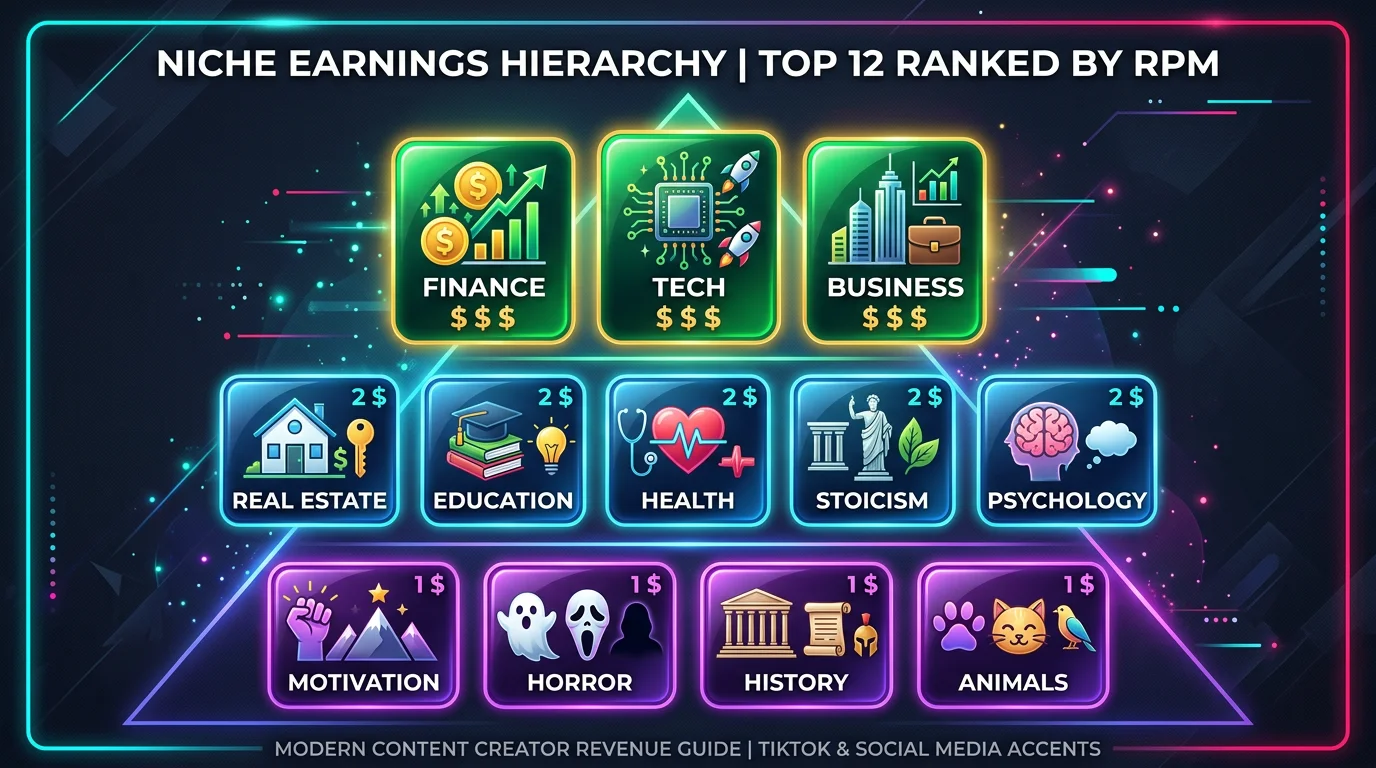
Finance, technology, business, and insurance are high-CPM niches on YouTube. Advertisers pay premium rates to reach these audiences. If your faceless content is in one of these niches, YouTube''s higher RPM makes it the more profitable platform from day one, even with slower growth. A faceless finance channel earning $8-15 RPM on long-form will outpace TikTok''s payouts at a fraction of the view count.
Content Longevity Matters to You
If you''d rather build a library of evergreen content that generates passive views for years, YouTube is your platform. Every video you post becomes a long-term asset. On TikTok, you''re always chasing the next viral moment. For detailed guidance on YouTube faceless video creation, see our guide on how to make faceless YouTube videos.
Frequently Asked Questions
Should I post the same video to TikTok and YouTube?
Yes. The 9:16 vertical format is identical on both platforms, and there''s no penalty for cross-posting the same content. Some creators remove TikTok watermarks before posting to YouTube (YouTube''s algorithm reportedly deprioritizes watermarked content), but the video itself can be identical. The simplest approach is to create one master video and distribute it to both platforms simultaneously.
Which platform pays more for faceless content?
For short-form content, TikTok currently pays more per view ($0.50-$1.00 per 1K views vs YouTube Shorts'' $0.01-$0.07 per view). However, YouTube''s total earning potential is higher because content generates views for much longer, and expanding to long-form unlocks dramatically higher RPMs ($2-$15 per 1K views). Over a 12-month period, a faceless YouTube channel typically earns more total revenue than a comparable TikTok account.
Can I grow on both platforms simultaneously?
Absolutely. Since the content format is the same, growing on both platforms requires no extra production work — only extra distribution. Post your faceless video to TikTok, then upload the same video as a YouTube Short. Many successful faceless creators maintain active presences on both platforms plus Instagram Reels, tripling their reach from a single video.
Is it harder to get monetized on TikTok or YouTube?
TikTok''s Creator Rewards Program requires 10,000 followers and 100,000 views in the last 30 days, plus videos over one minute for the best payouts. YouTube''s Shorts monetization requires 1,000 subscribers and 10 million Shorts views in 90 days. In practice, TikTok''s follower threshold is easier to reach (faster growth), but YouTube''s view threshold is extremely high. Most faceless creators reach TikTok monetization first, but earn more from YouTube over time.
The Bottom Line
For most faceless creators starting in 2026, TikTok is the better launchpad. The algorithm favors new accounts, growth is faster, and the feedback loop helps you improve quickly. But YouTube is the better long-term investment — evergreen content, higher monetization ceiling, and a path to long-form revenue.
The smartest move is not choosing one or the other. Start with TikTok to build momentum, cross-post to YouTube Shorts within 30 days, and let the data tell you where to focus. The content is the same. The format is the same. You''re just putting it in front of two different audiences.
Ready to start? Our complete faceless TikTok guide walks you through everything from niche selection to your first viral video.