Your Guide to YouTube Shorts Monetization Requirements
Unlock your earnings with our guide to YouTube Shorts monetization requirements. Learn the thresholds, steps, and tips to get monetized faster in 2026.
FlowShorts Team

So, you want to make money from your YouTube Shorts? The good news is, it's more accessible than ever. You now have two main ways to start earning: a faster track for fan funding with 500 subscribers and 3 million views in 90 days, or the full-blown ad revenue model at 1,000 subscribers and 10 million views in 90 days.
This tiered system is a game-changer. It means you don't have to wait for massive numbers to start generating income.
YouTube Shorts Monetization Requirements: Two Tiers Explained
The YouTube Partner Program (YPP) finally split its monetization path in two, recognizing that Shorts creators build audiences differently. Instead of one huge goalpost, you now have a milestone-based journey that lets you earn much sooner.
Think of it as climbing a ladder. The first rung gets you access to direct support from your community, while the top rung unlocks the bigger prize: a slice of the ad revenue pie.
The First Rung: Fan Funding
This initial tier is all about connecting with your most loyal viewers. Once you hit 500 subscribers and get 3 million valid Shorts views within a rolling 90-day period, you unlock "fan funding." This doesn't include ad money, but it gives your audience ways to support you directly.
This includes features like:
- Super Thanks: Viewers can purchase a fun animation on your Short to show their appreciation, and you get a share of that money. It’s basically a tip jar.
- Channel Memberships: You can offer exclusive perks—like badges, custom emojis, or members-only content—to fans who pay a monthly fee.
The Top Tier: Full YPP and Ad Revenue
This is the traditional goal. Reaching 1,000 subscribers and hitting 10 million valid Shorts views in 90 days gets you into the full YouTube Partner Program.
This gives you everything from the first tier, plus the main event: Shorts ad revenue sharing. You'll start earning a percentage of the revenue from the ads that play between videos in the Shorts feed.
The diagram below gives you a great visual breakdown of how these two paths work together, showing how you can progress from community support to full monetization.

As you can see, your earning journey can start much earlier, which is a huge motivator to keep creating.
To make it even clearer, let's break down exactly what you get with each monetization level. The requirements for 2026 continue this tiered approach, giving creators a clear roadmap for growth.
YouTube Shorts Monetization Tiers (2026 Requirements)
| Monetization Feature | Tier 1 Early Access (Fan Funding) | Tier 2 Full YPP (Ad Revenue) |
|---|---|---|
| Eligibility | 500 subscribers & 3M Shorts views | 1,000 subscribers & 10M Shorts views |
| Super Thanks | Yes | Yes |
| Channel Memberships | Yes | Yes |
| YouTube Shopping | Yes | Yes |
| Shorts Ad Revenue | No | Yes |
| Long-Form Ad Revenue | No | Yes (with 4,000 watch hours) |
This table really highlights the difference. The first tier is your entry point to earn from your community, while the second tier unlocks the passive income stream from ads.
Why This New System Is a Win for Creators
This tiered model for YouTube Shorts monetization requirements is a huge shift from the old all-or-nothing approach. It turns the long grind into a series of achievable wins.
Imagine you run a channel with quick cooking tips. Hitting 500 subscribers and 3 million views might only take a couple of months. Unlocking Super Thanks means your most dedicated foodie fans can start tipping you on that viral recipe—a powerful bit of encouragement and funding you can put right back into your videos.
The big idea here is that monetization isn't some far-off destination anymore. It's a progressive path with real opportunities to earn as you grow, starting with the very community you're building.
Getting that early validation proves you're on the right track. By the time you're pushing for the 10-million-view mark, you already have a community that's invested in your success. If you're interested in the finer points, you can learn more about how to make money on YouTube Shorts in our detailed guide. This structure ensures every creator has a clear shot at turning their passion into a real paycheck.
Unlocking Early Earnings with Fan Funding

For a long time, hitting the YouTube Partner Program requirements felt like a massive mountain to climb, especially for new creators. Thankfully, YouTube's newer monetization tiers have completely changed the game, giving you a much faster path to earning your first dollar through what's called fan funding.
Think of this as your first step into making money on the platform. It’s all about letting your most engaged viewers support you directly, well before you're eligible for the bigger ad-share program. This approach rewards consistent effort and helps you build a loyal community right from the start.
The First Milestone: What You Need to Qualify
The numbers for this entry-level tier are refreshingly achievable. You're aiming for 500 subscribers and 3 million valid public Shorts views within the last 90 days. On top of that, you just need 3 public uploads in the past 90 days, which is a low bar for any active creator.
Once you hit these targets, YouTube unlocks some fantastic tools that let your audience show their appreciation with their wallets.
- Channel Memberships: This is a big one. It lets you offer a monthly subscription where your biggest fans can pay a small fee for exclusive perks like custom badges, unique emojis, or even early access to your content.
- Super Thanks: My personal favorite. It’s basically a digital tip jar right on your Shorts. If someone loves a video, they can send a one-time payment that pops up as a fun animation. It’s a direct and instant way for them to say, "Hey, great job!"
- Super Chats & Super Stickers: If you ever go live, these are essential. Viewers can pay to have their comments highlighted in the chat or send animated stickers, making your live streams more interactive and profitable.
These features aren't just about the money; they build a real connection. Getting that first Super Thanks is an incredible feeling—it’s proof that people value what you're creating.
What Actually Counts as a "Valid" View?
This is a critical detail that trips up a lot of new creators. A "valid public Short view" comes from someone organically discovering and watching your video, usually through the Shorts feed or on your channel page.
A word of caution: views you get by paying for a Google Ads campaign to promote your Short do not count toward the 3 million view threshold. YouTube wants to see genuine, organic interest, not how much you can spend on advertising.
Also, make sure your videos are set to "public." Any views on videos marked as "private" or "unlisted" won't move the needle on your monetization goals. Your content has to be out there for everyone to see.
A Real-World Path to 3 Million Views
So, how does this actually play out? Let's say you start a channel called "Quick Cook," posting one simple, 30-second recipe Short every day. Things are slow at first, but then one of your videos—a clever trick for dicing onions—goes viral. It pulls in 500,000 views and brings you 200 new subscribers in a weekend.
You don't just stop there. You keep up the daily schedule. Over the next couple of months, a few more Shorts do really well, hitting anywhere from 50,000 to 150,000 views each. This consistent performance pushes your subscriber count past the 500 mark and gets your 90-day view count soaring past 3 million.
This isn't just a fairy tale. I've seen creators following this exact playbook hit these fan funding requirements in just 3-4 months. The combination of 500 subscribers, 3 public videos, and 3 million Shorts views is very doable with a solid content strategy. In fact, recent data shows that Shorts are accelerating creator qualification across the board.
Start Earning with Faceless Content
FlowShorts creates and posts monetizable short-form videos daily — no filming, no editing, no uploading.
Create Your First Video →By your third month, you've unlocked Super Thanks. Now, when you post that amazing one-pan dinner recipe, your loyal viewers can send you a few bucks. It might not be a fortune initially, but that early income is powerful validation and can help you buy better ingredients or gear for your next video, fueling your growth even more.
Achieving Full Ad Revenue from Your Shorts

While getting tips and memberships from fans is a great start, the real game-changer is unlocking full ad revenue through the YouTube Partner Program (YPP). This is where your channel graduates from a fun project into a legitimate business, earning money from the ads that run in the Shorts feed.
Getting there is a bigger climb, no doubt. The requirements are steeper, but the reward is a scalable income stream that pays you for every eligible view. This is the path for creators who are serious about turning their content into a career.
The Full YPP Thresholds
To qualify for full ad revenue sharing, YouTube wants to see that you can consistently build and engage an audience. It all comes down to two key numbers:
- 1,000 Subscribers: This is the magic number that proves you've built a core community around your content.
- 10 Million Valid Public Shorts Views: Here's the big one. You need to hit this target within a rolling 90-day period. It shows YouTube your content has what it takes to perform in the highly competitive Shorts feed.
Once you cross both of those thresholds, you can apply for the full YPP. This doesn't just give you fan funding—it opens the door to the most important income source: Shorts ad revenue.
Understanding the Shorts Monetization Module
Getting accepted into the YPP is a huge milestone, but there's one small, critical step that many creators miss. You have to manually accept the Shorts Monetization Module inside your YouTube Studio.
Crucial Tip: You will not earn a single cent from Shorts ads until you accept this module. Any views your Shorts accumulated before you accepted it are not eligible for retroactive pay. Make it a priority to accept this module the moment you are approved for the YPP.
Think of it as flipping the "on" switch for your earnings. Until you do, you're leaving money on the table.
How Shorts Ad Revenue Actually Works
The way YouTube calculates Shorts revenue is different from long-form videos, where an ad might run directly before or during your content. Instead, it's based on a pool system.
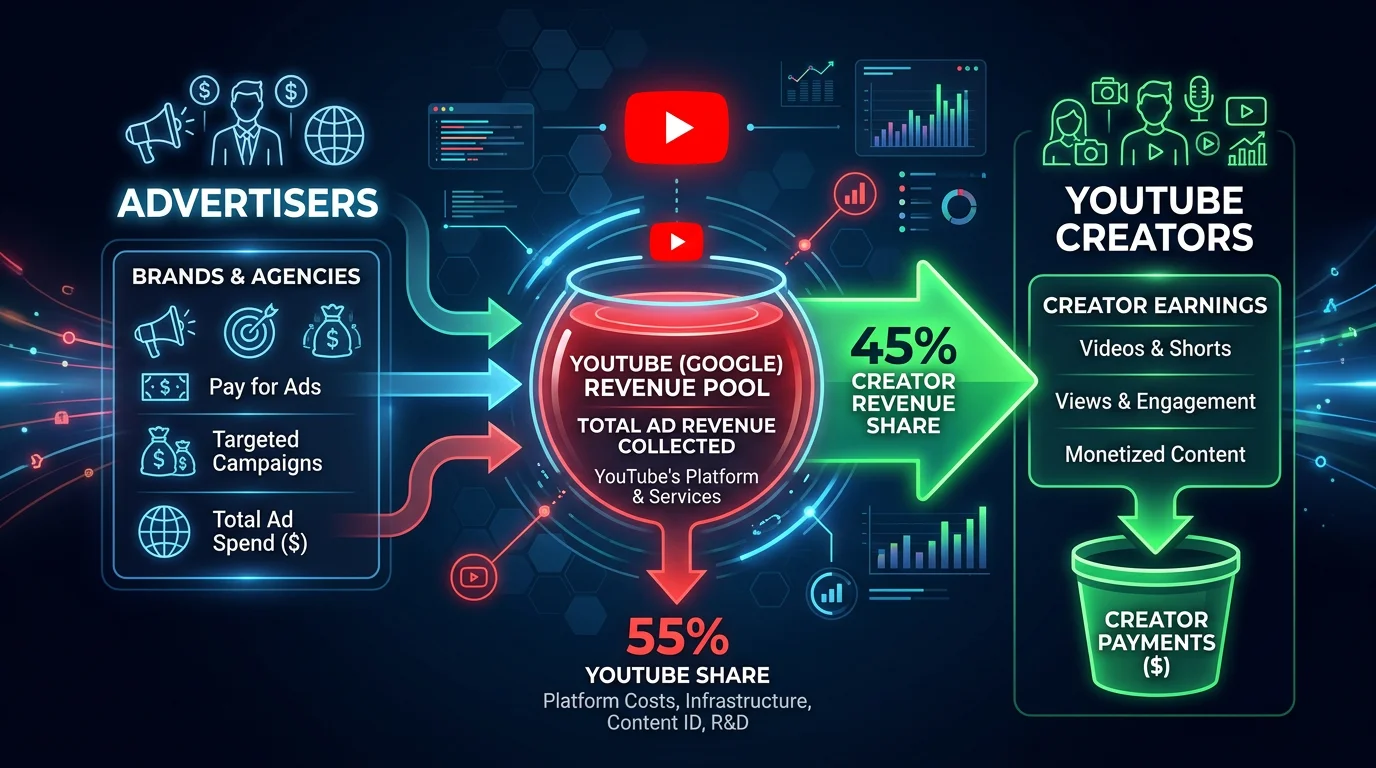
First, YouTube bundles all the revenue from ads shown between videos in the Shorts feed. From that big pot, they first pay for music licensing—this covers the costs of all the popular tracks creators use.
The money that's left over goes into what's called the "Creator Pool." This pool is then divided up among all monetizing creators based on their share of total views in their country. So, if your channel was responsible for 1% of all eligible Shorts views this month, you get 1% of the Creator Pool.
From that amount, you keep 45%. That's your cut.
While the RPM for Shorts is generally lower than for long-form content—often hovering between $0.01 to $0.06 per 1,000 views—the potential for massive view counts makes it incredibly powerful. We're seeing more and more evidence that Shorts monetization is rapidly growing and becoming a significant income driver for creators.
A Scalable Strategy for 10 Million Views
Hitting 10 million views in 90 days can feel like a monumental task. But with the right strategy, it's more of a numbers game than you might think.
Imagine a faceless channel in the "luxury lifestyle" niche. This kind of content—supercars, private jets, stunning mansions—is perfect for automation tools like FlowShorts, which can handle the entire creation process. Plans start free and you could set it up to generate a couple of new videos every day using high-quality stock footage, AI-generated scripts, and a compelling voiceover.
By consistently auto-posting, the channel builds momentum with the algorithm. Most of the daily videos might pull in a respectable 10,000-50,000 views. But every now and then, a video about a "billionaire's hidden bunker" or a "tour of a $100M yacht" catches fire and goes viral, bringing in 2-3 million views on its own.
Over 90 days, you only need a handful of those viral hits, propped up by the steady baseline from your daily posts, to easily blow past the 10 million view requirement. It’s not about getting lucky; it’s about creating a system that manufactures opportunities for virality through sheer, consistent output.
So, you've put in the work, hit your subscriber and view goals, and are finally eligible for monetization. That’s a huge milestone worth celebrating! But before you can start seeing the revenue roll in, you have to get through the official application process. It can feel a bit daunting, but I've walked countless creators through it, and with a little preparation, you'll be fine.
Once you meet the YouTube Shorts monetization requirements, you'll see a notification pop up right in your YouTube Studio. This is your invitation to apply for the YouTube Partner Program (YPP). The whole journey happens inside the "Earn" tab, so get familiar with it.
Getting the Paperwork Done: Terms and Modules
Right out of the gate, YouTube will ask you to review and accept the Base Terms. Think of these as the foundational rules for being a partner. After that, you'll be presented with different "Monetization Modules."
For Shorts creators, the most critical one is the Shorts Monetization Module. You absolutely must accept this to earn money from ads shown in the Shorts feed. It's a common mistake I see all the time—creators get accepted into the YPP but forget this crucial step and leave money on the table.
Key Takeaway: You won't earn a single penny from Shorts feed ads until you've accepted the Shorts Monetization Module. Any views your Shorts got before you accepted the terms are not paid retroactively, so make this your number one priority after getting approved.
The AdSense Hurdle: Linking Your Account to Get Paid
This is probably the biggest roadblock for new creators. To actually receive your money, you need an active Google AdSense account linked to your channel. You have two paths here:
- Link an existing AdSense account if you already have one set up.
- Create a new one during the application process if you're starting from scratch.
Here's the most important rule: you can only have one AdSense account in your name, ever. Trying to create a second one is a classic mistake that will get your application delayed or even rejected flat out.
After you link the account, AdSense needs to verify who you are and where you live. This usually means uploading a picture of a government-issued ID and then waiting for a physical piece of mail containing a PIN. Make sure the name and address you enter match your legal documents perfectly to avoid any frustrating back-and-forth.
Passing the Human Review
With the technical bits sorted, your channel goes to the final stage: a human review. Yes, a real person at YouTube will actually go through your channel to make sure everything is on the up and up. They're not just looking at your stats; they're evaluating the soul of your content.
This reviewer is checking for a few key things:
- Community Guideline Compliance: Your channel needs to be clean. No strikes for spam, hate speech, or other violations.
- Advertiser-Friendliness: Is your content safe for brands? Things like excessive swearing, super controversial subjects, or graphic material can get your channel demonetized or limit which ads can run.
- Originality and Reused Content: This is a big one, especially for Shorts. If your channel is just a collection of movie clips or unedited content you grabbed from TikTok, you're likely heading for a rejection.
I've seen channels with simple, original, faceless content get approved with no problem, while channels that just repost other people's work get stuck in review limbo. It's a smart move to do a quick audit of your own videos and remove anything that feels questionable before you apply. For a deeper dive on what's safe, our guide on how to monetize YouTube Shorts has you covered.
The review itself usually takes about a week, but don't panic if it stretches to a month—some channels just require a more thorough look. Once you're in, you’ll get that glorious approval email, and the "Earn" tab will unlock all your monetization tools. You're officially ready to start earning from your hard work.
Start Earning with Faceless Content
FlowShorts creates and posts monetizable short-form videos daily — no filming, no editing, no uploading.
Create Your First Video →Content Strategies to Hit Monetization Requirements Faster

If you want to hit your YouTube Shorts monetization requirements faster, it’s not about getting lucky—it's about having a game plan. Just tossing videos out there and hoping for the best is a slow, frustrating path. You need a real strategy that works with the algorithm to speed up your journey to those subscriber and view counts.
A great place to start is with your channel's core concept. While your sparkling personality can certainly carry a channel, I've found that "faceless" content often grows much, much faster. It's scalable, appeals to a wider audience, and lets the content do all the heavy lifting. Our guide on how to start a faceless YouTube channel covers the full setup.
Identify High-Retention Niches for Faceless Shorts
The secret to explosive growth is picking topics that are naturally addictive. You want content with built-in curiosity, where viewers absolutely have to stick around to get the answer or see the payoff.
From what I’ve seen, some of the best-performing faceless niches are:
- Personal Finance: Quick, actionable tips about money always grab attention. Think Shorts like, "3 Ways to Save $500 This Month." It's instantly valuable.
- Surprising Science Facts: Videos that drop a mind-blowing fact about the universe or our world are pure gold. Who wouldn't stop for a video titled "Why Glass is a Liquid"?
- Historical Oddities: Forget dry textbook lessons. Focus on the bizarre and lesser-known corners of history. A Short about "The Great Emu War" is way more interesting than a generic overview of WWII.
These niches are powerful because the content is the main attraction, not a person. This makes it way easier to churn out a high volume of quality videos, which is exactly what you need to build momentum fast.
Master the Crucial First Three Seconds
On the Shorts feed, you're in a constant battle for attention. You have roughly three seconds to give a viewer a compelling reason not to swipe away. If your intro is weak, you've lost them. It's that simple.
Your hook is everything. Start your video with a bold claim, a controversial question, or a visual that makes people stop and stare. Forget the fancy intro cards; jump straight into the good stuff.
Imagine a finance Short opening with the voiceover, "This simple habit could make you a millionaire," while showing a piggy bank shattering. It creates instant intrigue and makes viewers desperate for the answer. Your opening isn't just the start of your video—it's the sales pitch for watching the rest of it.
The goal of your first three seconds isn't to tell the story—it's to convince the viewer that the next 57 seconds are worth their time. A strong hook is the single most important factor for retention on Shorts.
Perfect Your Captions and Audio Choices
Captions and audio are not an afterthought; they're essential tools. A huge number of people watch with the sound off, so dynamic, easy-to-read captions are non-negotiable. Use them to highlight your key points and keep the viewer engaged.
At the same time, jumping on a trending audio track can give your video a massive discoverability boost. But don't just randomly pick a popular song. Make sure the audio actually fits the vibe of your content. When it feels forced, viewers can tell.
Here’s a pro tip: write your captions to encourage loops. Try ending your video with a line of text that perfectly leads back to the beginning. For a science fact video, the last caption could say, "...which is why glass is a liquid," just as the video restarts with that opening hook. It’s a simple trick that can seriously inflate your total watch time. For more ideas like this, check out our guide on how to get more views on YouTube Shorts.
Maintain a Consistent Posting Schedule
Finally, consistency is the name of the game. Posting daily, or at least several times a week, is a clear signal to YouTube that you're an active and reliable creator. The algorithm rewards this, and I've consistently seen active channels get more favorable treatment.
Of course, maintaining that pace can lead to serious burnout if you're doing it all by hand. This is where automation becomes a game-changer. Using a platform like FlowShorts' YouTube Shorts generator to handle scriptwriting, video creation, and scheduling keeps your channel running like clockwork, even when you're busy. This lets you focus on the big picture while your content engine does the work, making the path to meeting your YouTube Shorts monetization requirements much faster and far less stressful.
Your Questions on Shorts Monetization Answered
Even after reading the official rules, many creators are left with nagging questions about how YouTube Shorts monetization really works. It's one thing to know the numbers, but it's another to navigate the tricky situations that pop up on your journey to getting paid.
Let's clear up some of the most common gray areas I see creators wrestling with.
What Kind of Views Count Toward the 10 Million View Goal?
Not every view on your Short pushes you closer to that 10 million target. YouTube is pretty particular about what they consider a "valid public Short view," and understanding this is key.
The views you want are the organic ones—people discovering your content while scrolling through the Shorts feed. That’s the bread and butter. Views from your channel page or other places on YouTube where people find your Shorts also count.
However, thinking of running a Google Ads campaign to speed things up? Don't. Any views you get from paid promotion do not count toward your 10 million view goal. YouTube wants to see genuine, organic interest in your content, not how much you can spend on marketing.
Also, make sure your Shorts are set to public. Any videos you’ve marked as private or unlisted are invisible to the YouTube Partner Program's counters. A quick check of your video settings can save you a lot of headaches.
Can I Be Demonetized for Using Unoriginal Content?
Yes, and it happens all the time. Reusing content without adding significant value is one of the fastest ways to get your YPP application denied or, even worse, have your channel demonetized after you’ve already been approved.
YouTube's "reused content" policy is strict. You can't just download clips from movies, TV shows, or another creator's channel and upload them as-is. That’s a recipe for rejection.
To stay on the right side of the rules, your content needs to be transformative. This means you’re adding something new and original to the clip.
- Offer insightful commentary or a sharp critique.
- Use clips to teach something new.
- Weave them into a completely new story or narrative.
For instance, a channel that just uploads raw scenes from a popular TV show will almost certainly be rejected. But a creator who uses those same scenes to break down character development, adding their own unique voiceover and analysis, is creating something original. That’s the kind of transformative work YouTube wants to reward.
A smart approach for faceless channels is to pair licensed stock footage with a well-written, original script and a unique voiceover (either human or high-quality AI). In YouTube's eyes, that's a 100% original video, keeping your channel compliant and your revenue stream safe.
What If I Hit the Watch Hour Goal Before the Shorts Goal?
That’s great news! It actually puts you in a perfect position because you only need to hit one of the performance thresholds, not both.
To get into the full YouTube Partner Program, you need 1,000 subscribers and one of the following:
- 10 million valid public Shorts views in the last 90 days.
- 4,000 valid public watch hours from your long-form videos in the last 365 days.
Many creators mix Shorts and long-form videos. If your longer videos take off and you hit the 4,000-hour mark before your Shorts get to 10 million views, go ahead and apply for the YPP. Once you're in, all you have to do is go to your YouTube Studio and accept the Shorts Monetization Module. Just like that, you can start earning from your Shorts, too.
How Is Shorts Ad Revenue Actually Calculated and Paid?
The way Shorts revenue is calculated feels a bit different from traditional videos, but it’s a straightforward process once you break it down. Unlike long-form content, ads don't play directly on your specific Short; they appear between videos as people scroll the feed.
Here’s how the money flows:
Revenue Pooling: First, YouTube gathers all the money made from ads shown in the Shorts feed and puts it into one big pot. They take a cut from this to pay for music licensing fees. What's left over is the "Creator Pool."
Your Share of Views: Next, YouTube looks at your channel's performance. The Creator Pool is distributed to monetizing creators based on their share of total views in their country. If your Shorts got 0.5% of all eligible Shorts views in your country for the month, you are allocated 0.5% of that country's Creator Pool.
Your Payout: Finally, you get your cut. You receive a 45% revenue share from your allocated portion of the Creator Pool. These earnings are tallied up monthly and finalized in your AdSense account. Once your balance hits the $100 payment threshold, the money is sent your way.
Ready to stop worrying about manual content creation and start accelerating your growth? FlowShorts uses AI to create and auto-post faceless Shorts for you, helping you hit your monetization goals faster. Get started with FlowShorts today and put your channel on autopilot.
Related: YouTube Shorts Pay Rates (2026)
See earnings by niche: YouTube Money by Niche — real RPM data and monthly income estimates.