Back to Blog
FlowShorts
HomeBlogHow Much Does YouTube Pay for Shorts: 2026 Earnings
how much does youtube pay for shorts

How Much Does YouTube Pay for Shorts: 2026 Earnings

Ever wondered how much does YouTube pay for Shorts? Get the full 2026 breakdown: RPM, ad revenue, and your earnings from 1 million views.

F

FlowShorts Team

April 4, 2026•18 min read•0 views
How Much Does YouTube Pay for Shorts: 2026 Earnings

So, you want the bottom line: how much can you actually make from YouTube Shorts? The honest answer is that it varies, but most creators see a payout somewhere between $0.03 and $0.10 for every 1,000 views.

What does that look like in practice? A Short that hits 1 million views could earn you anywhere from $30 to $100. It's not a fortune for a single viral hit, but it's a real, predictable income stream that simply didn't exist a few years ago.

Your Quick Answer on YouTube Shorts Payouts

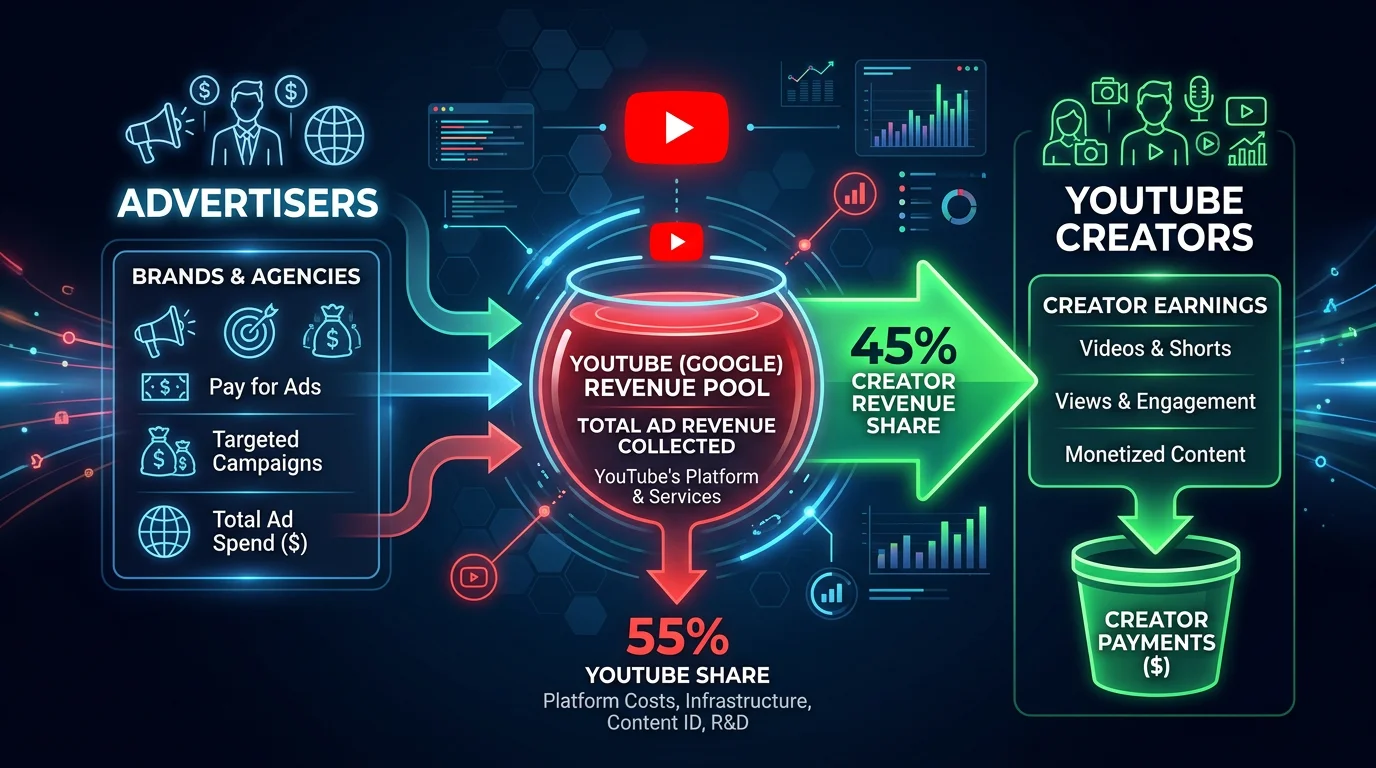
Gone are the days of the old, unpredictable YouTube Shorts Fund. We're now in the era of revenue sharing, which is a much clearer system. Creators get to keep 45% of the ad revenue that their Shorts generate.

Here's how it works. All the money from ads shown between Shorts in the feed goes into a big pot called the "Creator Pool." Before anyone gets a slice, YouTube uses some of that money to pay for music licenses. The rest is what gets divided up among all the monetized creators. Your share of that pool is determined by your share of the total valid views on the platform for that month.

Think of it this way: if your Shorts accounted for 1% of all eligible views across the entire platform in a given month, you’d receive 1% of the money in the Creator Pool. It directly ties your earnings to your performance.

Estimated YouTube Shorts Earnings by View Count (2026)

To help you get a better feel for the numbers, it's useful to look at potential earnings based on that typical $0.03 to $0.10 RPM (Revenue Per Mille, or earnings per 1,000 views) range. Keep in mind that your actual RPM can swing based on your audience's location, the topics you cover, and even the time of year.

This table provides a quick estimate of potential earnings from YouTube Shorts based on typical RPM ranges, from low-end to high-end scenarios.

Total Views Potential Earnings (Low-End at $0.03 RPM) Potential Earnings (High-End at $0.10 RPM)
100,000 $3 $10
500,000 $15 $50
1,000,000 $30 $100
5,000,000 $150 $500
10,000,000 $300 $1,000

As you can see, the numbers really start to add up as your channel scales. While a single video's payout might seem small, a channel consistently generating millions of views per month can build a significant income stream.

The Evolution of Shorts Monetization

This system is a huge step up from where we started. The original Shorts Fund was more like a lottery—a monthly bonus handed out to top creators with no clear formula. The current revenue-sharing model gives creators a stable, albeit modest, income that grows with their channel.

Let’s look at a real-world example from our friends at vidIQ. In the early days of the new model, they published a case study on a Short that got 468,500 views and earned just $16.61. That works out to a pretty low RPM.

But things are getting better. As advertisers have become more comfortable with the format, RPMs are climbing. Today, with an RPM closer to $0.10, that same video could have earned around $46.85. It's a clear sign of the growing potential in Shorts.

Of course, there's more to it than just getting views. Later in this guide, we'll break down exactly what counts as a "monetizable view" and explore the strategies you can use to push your earnings toward the higher end of that spectrum.

How the Shorts Revenue Share Model Really Works

Let's break down how you actually get paid for your Shorts. Think of all the money from ads shown in the Shorts feed as one big pot of cash. Under the old Shorts Fund, YouTube would hand out money to a handful of top creators, but it was a total black box—nobody knew who got paid or why. Now, the revenue share model gives every eligible creator a clear, predictable slice of the pie.

The whole system is much more transparent than you might think and follows four simple steps. It's designed to reward every creator who contributes views, not just a lucky few.

This diagram gives you a quick visual of how views turn into cash in your pocket.

A process flow diagram illustrates YouTube Shorts earnings: 1K views lead to $0.03-$0.10 revenue, then a 45% creator share.

As you can see, a thousand views generate a few cents of revenue. From there, the money is pooled and distributed, with your cut being a fixed 45% of what you're allocated.

Step 1: All Ad Revenue Is Pooled Together

First things first, YouTube gathers every single dollar made from ads that appear between videos in the Shorts feed. Unlike regular long-form videos, where an ad runs directly on your content, Shorts ads are separate from any one creator's video. That’s why all the revenue has to be collected in one central pot.

This approach ensures that if your Short was part of a viewing session that included an ad, you get a piece of the action. It's a team effort, so the earnings are pooled together for everyone.

Step 2: Music Licensing Costs Are Subtracted

Before a single creator sees a dime, YouTube has to pay the bills. A massive number of Shorts use popular music, and the artists and labels behind those tracks need to get paid. So, YouTube subtracts the cost of all music licensing from that central revenue pot.

What’s left over is what YouTube calls the Creator Pool. This is the actual money that’s up for grabs among all monetizing Shorts creators.

Key Insight: The size of the Creator Pool isn't fixed; it changes every single month. The final amount depends on how much advertisers spent and how much music was used across the platform.

Step 3: Your Share Is Calculated Based on Views

So, how does YouTube decide your piece of that Creator Pool? It’s all about your share of the total views.

If your Shorts were responsible for 1% of all the views on monetized Shorts in your country for that month, you get allocated 1% of the money from the Creator Pool. It’s that direct. If you want to dig deeper into turning those views into real income, this guide on how to monetize YouTube Shorts is a great resource.

Let’s use a simple example straight from YouTube's own playbook. If the Creator Pool is $90,000 after music costs are paid, and your channel drove 1% of the total views, you’d be allocated $900.

Step 4: You Receive Your 45% Cut

This is the final and most important step: getting paid. From the money allocated to you from the Creator Pool, you keep a flat 45%. The other 55% goes to YouTube.

Let's finish our example:

  • Your allocated share from the Creator Pool was $900.
  • Your final payout is 45% of $900, which comes out to $405.

This 45% cut is the same for every creator in the YouTube Partner Program, which brings a level of fairness and predictability that was missing before. Now you know exactly where you stand. To see how this fits into the bigger picture, check out our full guide on https://www.flowshorts.app/blog/how-to-monetize-youtube-shorts.

Key Factors That Determine Your Shorts RPM

A light wooden desk features a thumbs-up object, a globe, a 'RPM Drivers' bar chart, and a black smartphone.

You've probably heard the wide range of potential earnings, with some Shorts getting as little as $0.03 RPM and others hitting $0.10 or more. So, why the huge gap? It all comes down to a simple truth: not all views are created equal in the eyes of advertisers.

Think of it like this: a tomato sold at a high-end organic market in a major city will sell for a much higher price than the exact same tomato at a rural roadside stand. Your Shorts views work the same way. Their value is all about who is watching, where they're from, and what kind of content they're consuming.

Once you get a handle on these factors, you can stop chasing empty views and start attracting the right kind of audience—the kind that advertisers are willing to pay more to reach.

Viewer Location and Audience Demographics

If there's one factor that has the biggest impact on your Shorts RPM, it's this one. Where your viewers are located matters immensely because advertisers pay a premium to reach audiences in countries with more spending power.

A view from someone in the United States, the UK, or Canada can be worth several times more than a view from a country with a less mature ad market. Companies in those top-tier regions simply have bigger budgets and are fighting harder for every eyeball.

It's helpful to think of the world in a few tiers for advertising:

  • Tier 1 Countries (Highest RPM): United States, Canada, United Kingdom, Australia, Germany.
  • Tier 2 Countries (Mid-Range RPM): Most of Western Europe, Japan, South Korea.
  • Tier 3 Countries (Lowest RPM): Many countries in Southeast Asia, Latin America, and Africa.

This means a creator with one million views mostly from the US can easily out-earn another creator with five million views scattered across Tier 3 countries.

Your Content Niche Matters

Right alongside who is watching is what they're watching. The topic of your Shorts directly impacts which advertisers show up to bid for a spot in that ad pool. Some niches are just naturally more profitable because they pull in an audience that specific businesses are desperate to connect with.

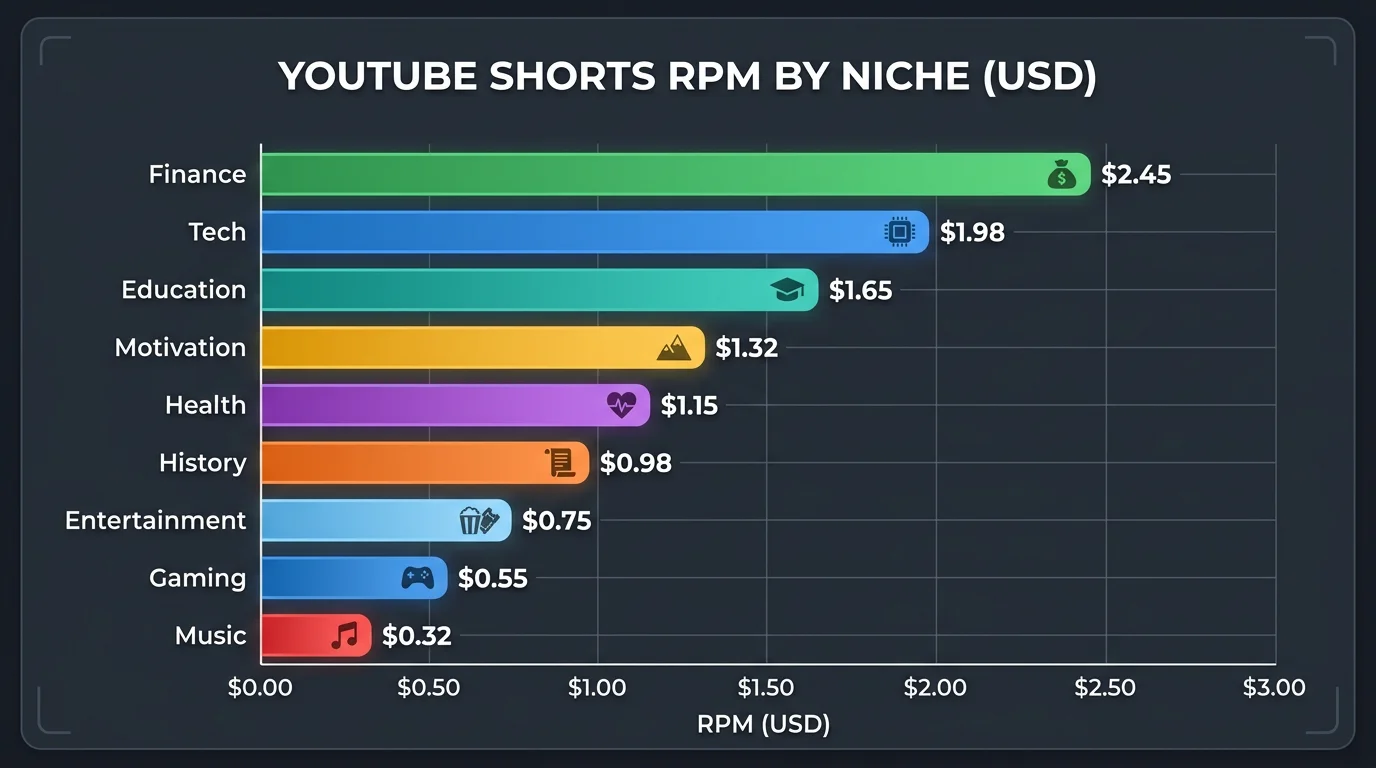
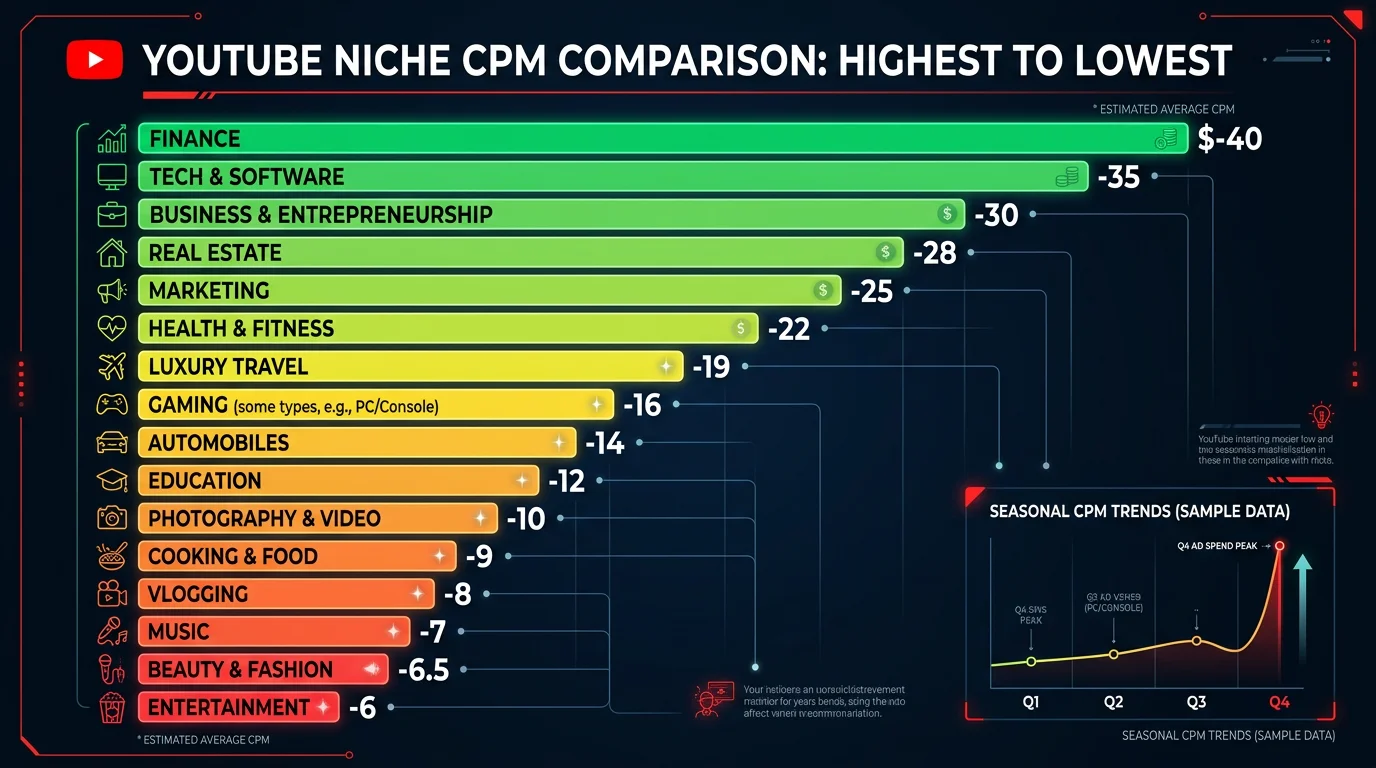
For instance, content about personal finance, technology, real estate, and business software almost always pulls in a higher RPM. Why? The advertisers in those spaces are selling expensive products and services, so they're willing to pay top dollar to get in front of a potential customer.

Key Insight: A Short explaining a new investing app is almost guaranteed to have a higher RPM than a general comedy or dance Short. The finance video attracts viewers who advertisers see as having disposable income and an interest in financial products.

On the other hand, broad entertainment niches like dance trends or funny animal videos tend to have lower RPMs. While they can rack up absolutely massive view counts, the audience is very general, which leads to lower, less competitive ad bids.

Engagement Quality and Valid Views

Here's something many creators overlook: not every view on your Shorts counter actually earns you money. YouTube's system only counts what it calls a "valid engaged view." The exact formula is a closely guarded secret, but the core idea is that a person has to actually watch your Short for a meaningful amount of time—not just flick past it in a split second.

This system rewards genuine interest, not just quick, empty impressions. A Short that consistently keeps people watching will always perform better financially than one with a big view count but terrible watch time.

There’s another layer to this, too: YouTube Premium. When a Premium subscriber watches your Short, you get a cut of their subscription fee. This creates a separate, often more predictable income stream that doesn't depend on ad bids at all, rewarding you directly for making great content that members value.

Calculating Your Potential Earnings with Real Examples

Okay, enough with the theory. Seeing the actual numbers is what really makes the lightbulb go on. Let's walk through a few real-world scenarios to see how this all shakes out.

The core formula for estimating your Shorts income is refreshingly simple.

(Total Views / 1,000) x RPM = Estimated Earnings

Using this, you'll quickly see that it’s not always about getting the most views. Sometimes, it's about getting the right views from the right audience.

Scenario 1: The Classic Viral Short

Imagine you post a hilarious, on-trend video. It catches fire, and boom—you hit 1 million views. Because it’s general entertainment with a worldwide audience, your RPM is on the lower side, let's say $0.04.

Here's how that breaks down:

  • (1,000,000 Views / 1,000) x $0.04 RPM = $40.00

Now, $40 for a million views might sound low. But don't forget the other benefits: this type of video is an incredible engine for gaining subscribers and growing your channel fast.

Scenario 2: The High-Value Niche Short

Now, let's flip that on its head. You're a creator in the personal finance niche, and you post a Short breaking down a smart tax-saving strategy. It’s specialized content, so it pulls in a more modest 500,000 views.

The key difference? Your audience is incredibly valuable to advertisers in that space. This can push your RPM to the higher end of the spectrum, maybe around $0.10.

Let's do the math on that:

  • (500,000 Views / 1,000) x $0.10 RPM = $50.00

Look at that. With half the views, this Short actually earned more money. This is the power of a targeted, high-value niche in action.

Scenario 3: The Global Entertainment Juggernaut

Finally, what about sheer, overwhelming volume? Think of a creator making dance or challenge videos that go viral across the globe, especially in what we call Tier 2 and Tier 3 countries. The video racks up a staggering 5 million views.

Because the audience is so broad and heavily concentrated in ad markets with lower advertiser spend, the RPM might be at the bottom of the scale, around $0.03.

Here’s the final calculation:

  • (5,000,000 Views / 1,000) x $0.03 RPM = $150.00

Even with a tiny RPM, the massive view count delivers the biggest payout of all three scenarios. This isn't just theory; real-world data from creators backs this up. One creator, for instance, famously earned around $70,000 from 580 million views over a few years. You can explore detailed reports on Shorts earnings to see more firsthand accounts.

Scenario Comparison: Shorts Earning Potential

Putting these examples side-by-side gives you a clear snapshot of how your strategy—niche, audience, and engagement—can dramatically affect your income.

Scenario Total Views Assumed RPM Estimated Earnings
Typical Viral Short 1,000,000 $0.04 $40.00
High-Value Niche Short 500,000 $0.10 $50.00
Global Entertainment Short 5,000,000 $0.03 $150.00

Ultimately, this comparison highlights the fundamental choice every Shorts creator faces. Do you chase broad, viral appeal that depends on massive volume, or do you cultivate a specific, high-value audience that pays more per thousand views?

If you want to play around with your own numbers, our YouTube Shorts money calculator is a great tool for projecting what your channel could potentially earn.

Strategies to Increase Your Shorts Earnings

A desk setup with a calendar, laptop, phone on a tripod, and notebook, symbolizing online content creation for boosting earnings.

Knowing how the Shorts payment model works is the first step. The real game, though, is figuring out how to actively push your earnings higher. It's about taking your RPM from the low end of the scale and getting it closer to that coveted $0.10 mark—and that takes a smart, deliberate approach.

This isn't just about chasing viral sounds or copying the latest trend. It’s about creating content that advertisers actually want to be associated with and that the YouTube algorithm can't help but promote. The goal is to get better views, not just more of them.

Target High-RPM Niches and Audiences

Let's be blunt: not all views are worth the same amount of money. The most direct way to boost what YouTube pays for your Shorts is to create content for an audience that advertisers are fighting to get in front of.

This really boils down to two key things: picking the right topics and attracting viewers from the right places.

  • Profitable Niches: Think about fields where big money is spent. Content about personal finance, real estate, business, and technology naturally attracts higher-paying advertisers. When your videos get watched, that higher-value ad revenue flows into the Creator Pool.

  • Geographic Targeting: You need to think about who is watching. Tailoring your Shorts to appeal to audiences in Tier-1 countries like the United States, the UK, Canada, and Australia can make a massive difference. Use examples, humor, or topics that resonate in those regions to draw in the viewers that bring in the highest RPMs.

Even a small shift in your audience's location can have a surprisingly big impact on your monthly payout.

Master the Art of the "Valid Engaged View"

YouTube has a fancy term for what they pay for: "valid engaged views." All this really means is that people have to actually watch your Short, not just flick past it in their feed. Your watch time and audience retention are everything, both for the algorithm and for your bank account.

Key Takeaway: The longer someone watches, the more that view is worth. The algorithm sees high retention as a quality signal, so it pushes your Short to more people. This creates a snowball effect, multiplying your views and potential income.

You have to hook them fast. Grab their attention in the first 1-2 seconds to stop the scroll. Use quick cuts, clear on-screen text, and tell a story that keeps them locked in until the very end. The more you do this, the more the algorithm learns to love your channel.

If you're serious about this, check out a complete YouTube Shorts success blueprint that breaks down how the pros turn their views into real income.

Scale Your Content Production with Automation

On YouTube, consistency is king. The algorithm loves channels that post daily, or even multiple times a day. This constant stream of content tells YouTube you're a serious creator, and it builds momentum that can lift your entire library of videos, not just the new ones.

Of course, trying to keep up that pace is a one-way ticket to burnout. That's where tools like FlowShorts can give you a serious edge. By automating the creation of faceless Shorts in those high-RPM niches we talked about, you can keep your channel buzzing with activity without spending all day editing.

Here’s what that approach unlocks:

  • A relentless posting schedule that the algorithm can't ignore.
  • The ability to test different topics and styles at scale to quickly find what works.
  • A growing library of content that earns for you 24/7, compounding over time.

By combining a smart niche strategy with the power of automation, you can build a truly sustainable income stream from Shorts. For more ideas on this, see our guide on how to get more views on YouTube Shorts.

Common Questions About YouTube Shorts Payouts

Alright, we've gone through the nuts and bolts of the revenue share model, but I know there are still some tricky "what if" scenarios bouncing around in your head. Let's clear up a few of the most common questions creators have about how Shorts money actually works.

Do You Get Paid for Shorts with Copyrighted Music?

Yes, you can... but it's a big "but." The moment you add a popular song to your Short, you're essentially bringing a new business partner into the deal: the music rights holder. This split happens before your share is even calculated.

Here's how to think about it: YouTube takes the total revenue from your Short and first pays the music label its cut. Only after that's done is the remaining amount split 55% to YouTube and 45% to you.

The bottom line: Using just one copyrighted song can easily slice your potential earnings for that Short in half. If you use two tracks, you’re splitting the initial pot three ways (you and two music partners), leaving you with pennies. If your goal is to maximize your income, original audio is always the smartest play.

When Do You Actually Receive Your First Shorts Payment?

Getting that first payment from YouTube is a great feeling, but it’s not an instant transfer. It all runs on a predictable monthly schedule through your AdSense account, and it all starts once you hit the $100 payment threshold.

Here’s a breakdown of the typical timeline:

  1. Month 1 (e.g., January): You create Shorts and your channel earns money all month long.
  2. Month 2 (Mid-February): Your January earnings are finalized and officially added to your AdSense balance, usually sometime between the 7th and 12th.
  3. Month 2 (Late February): If your total AdSense balance is over $100, YouTube sends the payment out between the 21st and 26th of the month.

So, if you earn $110 in January, you won't see that cash until late February. If you only earn $50 in January, that balance just sits and rolls over until your earnings eventually cross that $100 mark.

Are Shorts Worth It Compared to Long-Form Videos?

If you just stare at the raw numbers, it's a no-brainer. Long-form videos almost always win on a per-view basis. A standard long-form RPM might be $3-$5, while a Shorts RPM often lands somewhere between $0.03-$0.10.

But that's like comparing apples and oranges—it misses the point completely. Shorts are, without a doubt, the single best tool we have right now for discovery and explosive channel growth. A single Short can go viral and bring in tens of thousands of subscribers in a week, something that's incredibly difficult and rare for a long-form video.

The winning strategy isn't to choose one over the other; it's to use both together. Think of Shorts as the top of your funnel—they are magnets for attracting a massive audience. You then direct that traffic to your more profitable long-form videos, affiliate products, or brand deals. That's how you build a sustainable, powerful income machine on YouTube.


Feeling the pressure to keep up with that content treadmill? Scaling your channel to build a real income stream doesn't have to lead to burnout. FlowShorts uses AI to create and auto-post faceless videos for you daily, keeping your channel growing 24/7. See how FlowShorts can do the work for you.

Tags

#how much does youtube pay for shorts#shorts monetization#youtube shorts rpm#creator earnings#youtube partner program

Share this article

Ready to Create Your Own Viral Videos?

Start creating AI-powered short videos today with FlowShorts.

Get Started Free
© 2026 FlowShorts. All rights reserved.