YouTube Shorts Fund: How Revenue Sharing Actually Works (2026)
How YouTube''s Shorts revenue sharing model works in 2026. Explains the 45% creator pool, how earnings are calculated from the ad pool, what counts as a qualified view, and realistic Shorts earnings at different view levels.
FlowShorts Team
YouTube replaced the old Shorts Fund with a proper revenue sharing model back in February 2023. The new system is objectively better for creators, but the way money actually flows from advertisers to your bank account is confusing. Most creators have no idea how their Shorts earnings are calculated, and that lack of understanding costs them money.
This guide breaks down the exact mechanics of how the YouTube Shorts revenue share works in 2026: how the ad pool is divided, what percentage you actually keep, how music licensing eats into your earnings, and what realistic Shorts income looks like at different view levels. If you want the full picture of every way to make money from Shorts, read our complete guide to monetizing YouTube Shorts.
Old Shorts Fund vs New Revenue Sharing
Before the current system, YouTube ran a fixed Shorts Fund: a $100 million pool distributed across 2022 and early 2023. It was invitation-only. YouTube would reach out to creators whose Shorts performed well that month and offer a bonus payment ranging from $100 to $10,000. You had no control over whether you qualified, no transparency into how payments were calculated, and no way to predict your income.
The new revenue sharing model, which launched alongside the expanded YouTube Partner Program, replaced that system entirely. Instead of a fixed pool, creators now earn a percentage of actual ad revenue generated by Shorts. The key differences:
- Old Fund: Fixed $100M pool, invitation-only, unpredictable payments of $100-$10,000/month
- New Model: 45% ad revenue share, available to all YPP creators, scales directly with your views
The new model is more transparent and scales infinitely. There is no cap. If Shorts ad revenue grows (and it has been growing significantly), your earnings grow with it. That said, the per-view payout on Shorts is still dramatically lower than long-form content, which we will cover below.
How YouTube Shorts Revenue Sharing Works
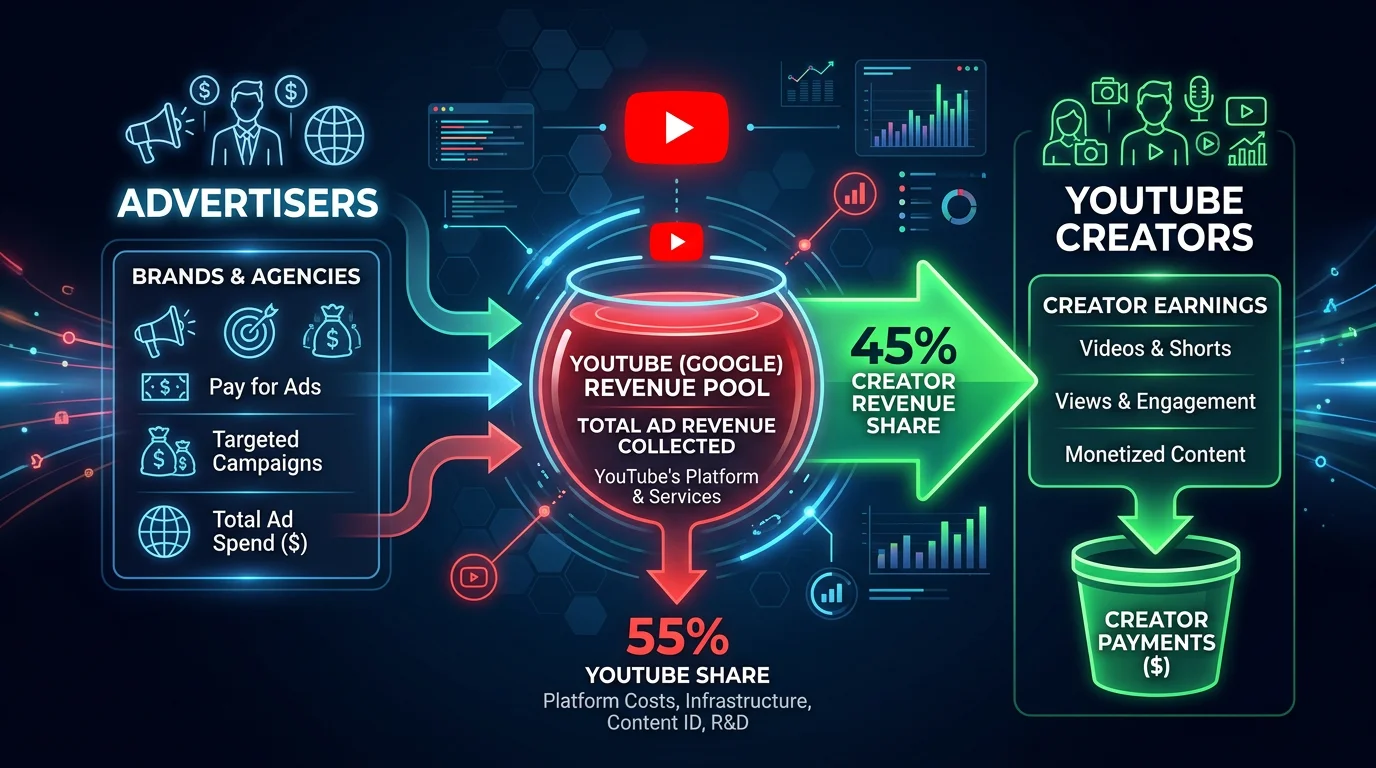
The Shorts revenue sharing model is not as simple as "you get 45% of ad revenue on your video." There are no ads on individual Shorts. Instead, the system works through a pooled allocation model. Here is the step-by-step breakdown:
Step 1: Ads Play Between Shorts in the Feed
As viewers scroll through the Shorts feed, ads appear between videos. These ads are not attached to any specific creator's content. They run in the gaps between Shorts, similar to how ads work in Instagram Stories or TikTok.
Step 2: YouTube Pools All Shorts Ad Revenue
All ad revenue generated across the entire Shorts feed gets combined into a single pool. This is the total money advertisers paid for Shorts ad placements during that period.
Step 3: Revenue Is Allocated Based on Your Share of Views
YouTube calculates what percentage of total Shorts views your channel received during the period. If your Shorts got 0.001% of all Shorts views globally, you are allocated 0.001% of the total ad revenue pool. This is your "creator pool allocation."
Step 4: You Keep 45% of Your Allocated Amount
From your allocated share, YouTube takes 55% and you keep 45%. This is the standard Shorts revenue split for all YPP creators. For context, on long-form videos the split is 55% to creators and 45% to YouTube, so Shorts creators get 10 percentage points less.
Step 5: Music Licensing Costs Are Deducted
If your Short uses licensed music from YouTube's music library, the revenue allocation for that video is split between you and the music rights holders before the 45% cut is applied. If your Short uses one licensed track, the revenue for that video may be split 50/50 with the music publisher. If it uses two tracks, you might only get a third.
Create Faceless Videos on Autopilot
FlowShorts generates and posts AI videos to YouTube, TikTok & Instagram while you sleep.
Try FlowShorts Free →This is a critical detail most creators overlook. Using original audio means you keep your full 45% share. Using copyrighted music can cut your earnings in half or more. If you are creating Shorts primarily for revenue, original voiceover and sound effects will significantly outperform trending audio clips in terms of earnings per view.
How Much Do YouTube Shorts Pay?
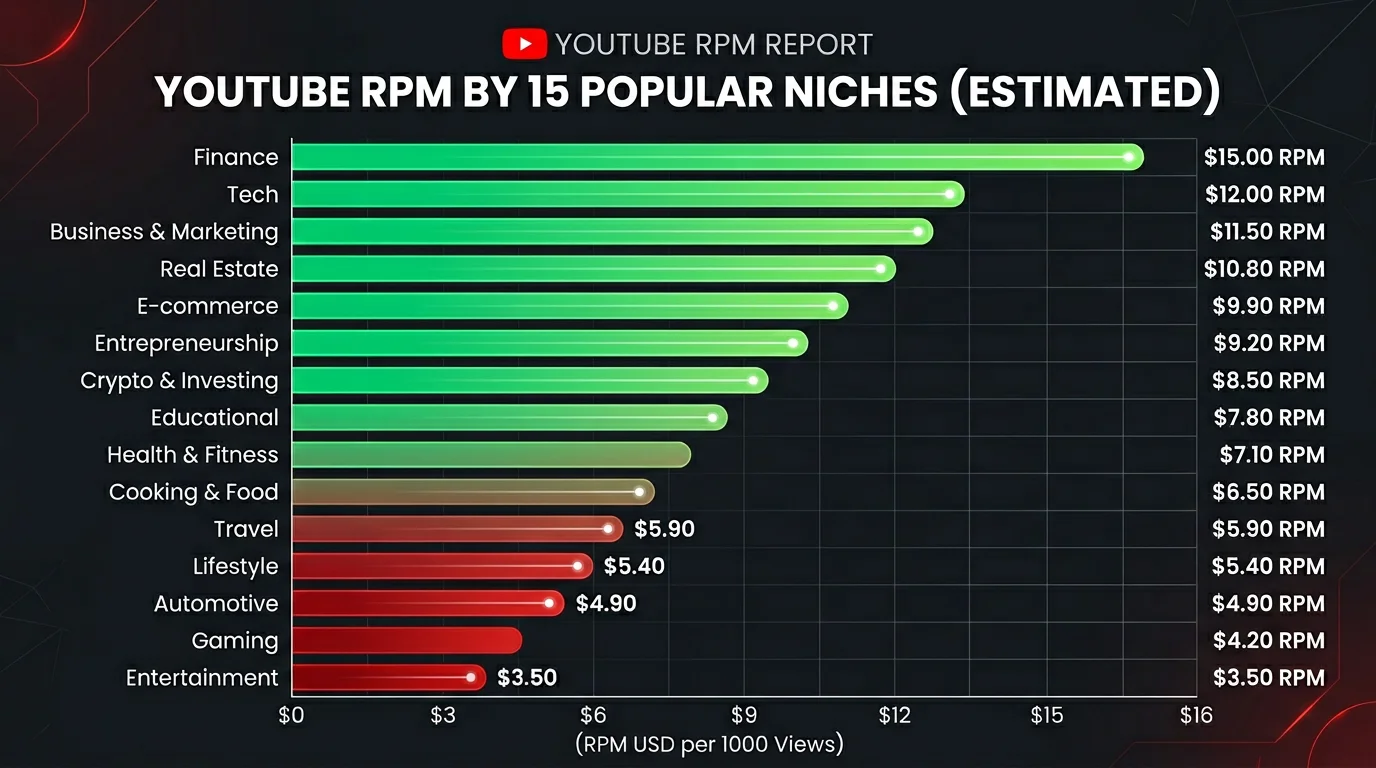
Shorts earnings vary based on your audience's geographic location, your niche, the time of year (Q4 ad spend is highest), and whether you use licensed music. The table below shows estimated earnings ranges based on aggregated creator reports in 2026. For deeper data on how niche affects earnings, see our breakdown of YouTube ad revenue by niche.
| Views | Estimated Earnings (Original Audio) | Estimated Earnings (Licensed Music) |
|---|---|---|
| 10,000 | $0.10 - $0.70 | $0.05 - $0.35 |
| 100,000 | $1 - $7 | $0.50 - $3.50 |
| 1,000,000 | $10 - $70 | $5 - $35 |
| 10,000,000 | $100 - $700 | $50 - $350 |
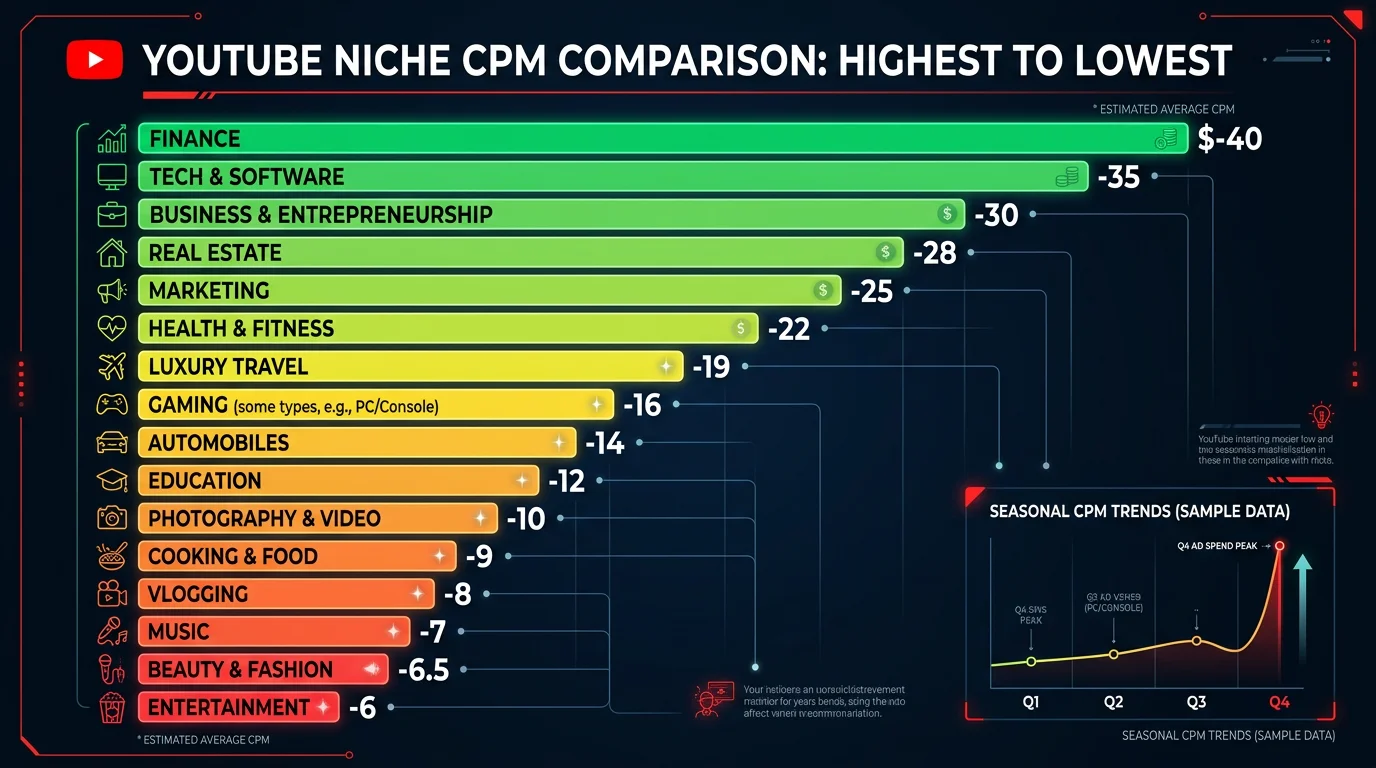
The wide ranges reflect real variance. A finance Short watched primarily by US viewers in December could earn toward the top of that range. A gaming Short watched by viewers in Southeast Asia in January will be at the bottom. Check current YouTube CPM rates by niche to understand why these ranges exist.
The effective RPM (revenue per 1,000 views) for Shorts typically falls between $0.01 and $0.07, compared to $2-$12 for long-form content. That is not a typo. We will address this gap directly in the comparison section below.
What Counts as a Qualified View?
Not every view on your Short counts toward your revenue allocation. YouTube applies specific criteria to determine "qualified views" for the Shorts revenue share:
- The view must come from the Shorts feed. Views on your Short from your channel page, external embeds, or search results do not count toward the Shorts ad revenue pool allocation. Only swipes in the Shorts feed generate ad impressions, so only those views are part of the revenue calculation.
- The viewer's country matters. Views from countries where Shorts ads are served count. YouTube has been expanding Shorts ad availability, but ad fill rates still vary significantly by region.
- You must be in the YouTube Partner Program. You need to meet the Shorts monetization requirements: either 1,000 subscribers plus 10 million Shorts views in 90 days, or 1,000 subscribers plus 4,000 watch hours on long-form content. Until you are in YPP, your views generate zero revenue.
- Replays count. If a viewer watches your Short multiple times in the feed, each play counts as a separate view for revenue allocation purposes.
Understanding qualified views matters because your YouTube analytics might show 1 million views on a Short, but your revenue-eligible views could be meaningfully lower depending on traffic sources.
Shorts Revenue vs Long-Form Revenue
The earnings gap between Shorts and long-form YouTube content is the elephant in the room. Here is a direct comparison:
| Metric | YouTube Shorts | Long-Form Videos |
|---|---|---|
| Revenue Split | 45% to creator | 55% to creator |
| RPM (per 1K views) | $0.01 - $0.07 | $2 - $12 |
| Ad Model | Pooled (between videos) | Direct (on your video) |
| 1M Views Earnings | $10 - $70 | $2,000 - $12,000 |
| Earnings Predictability | Low | Moderate |
Long-form content pays roughly 30x to 170x more per view than Shorts. This is because long-form videos can run multiple mid-roll ads directly on your content, while Shorts rely on a shared pool from feed ads. The math is straightforward: advertisers pay more for longer attention, and that longer attention is attributed directly to your video rather than split across millions of creators.
Does this mean Shorts are not worth it for revenue? Not necessarily. Shorts are dramatically easier to produce at volume, and a single viral Short can drive tens of thousands of subscribers to your channel, where they watch your long-form content. For a detailed look at how much YouTube pays for Shorts, we break down the numbers further. The real value of Shorts is often in the audience growth rather than direct ad revenue.
5 Tips to Maximize Shorts Revenue
If you are serious about earning from Shorts, these strategies will help you get the most from the revenue sharing model:
1. Use Original Audio
Create Faceless Videos on Autopilot
FlowShorts generates and posts AI videos to YouTube, TikTok & Instagram while you sleep.
Try FlowShorts Free →This is the single highest-impact change. Every Short with licensed music splits your revenue allocation with music publishers before your 45% is calculated. Original voiceover, original sound effects, and royalty-free audio let you keep your full share. If you use FlowShorts to generate your Shorts, the AI-generated voiceover and background music are original audio, so there is no licensing deduction.
2. Target US, UK, and High-CPM Audiences
Ad rates vary dramatically by country. A view from a US-based viewer generates significantly more ad revenue than a view from a lower-CPM region. Create content that appeals to English-speaking audiences in high-CPM countries. This does not mean you need to be in those countries yourself, just that your content resonates with viewers there.
3. Post in High-CPM Niches
Finance, business, technology, and health niches command higher ad rates because advertisers in those categories pay premium CPMs. A finance Short earning $0.05 per 1,000 views will still outperform a meme Short earning $0.01 per 1,000 views, even with fewer total views. Our CPM rates by niche guide has the full breakdown.
4. Post Consistently
The revenue sharing model rewards total views over a period. Posting daily (or even multiple times per day) compounds your view count and increases your share of the total Shorts view pool. Consistency also signals to the algorithm that your channel is active, which can boost distribution. Check our guide on how many Shorts to post per day for optimal frequency.
5. Create Longer Shorts
YouTube has expanded the maximum Shorts length to 3 minutes. Longer Shorts mean more watch time per view, and creators have reported that longer Shorts (60-90 seconds) tend to perform better in the algorithm than very short clips (under 15 seconds). More watch time per viewer also means more ad impressions in the feed around your content. Use our YouTube money calculator to estimate potential earnings at different view levels.
Frequently Asked Questions
Is the old YouTube Shorts Fund still available?
No. The original $100 million Shorts Fund ended in early 2023 and was fully replaced by the current revenue sharing model. All Shorts monetization now goes through the YouTube Partner Program's ad revenue share system. There is no separate fund or bonus pool.
How much does YouTube pay per 1,000 Shorts views?
The effective RPM for Shorts ranges from $0.01 to $0.07 per 1,000 views, depending on your audience location, niche, time of year, and whether you use licensed music. US-focused finance and business content tends to earn at the higher end. Entertainment and gaming content from lower-CPM regions earns at the lower end.
Why are Shorts earnings so much lower than long-form?
Three reasons. First, Shorts ads run between videos in a shared feed, not directly on your content, so revenue is pooled and split among all creators. Second, Shorts viewers watch for seconds, not minutes, generating far fewer ad impressions per viewer. Third, the creator revenue split is 45% for Shorts versus 55% for long-form content.
Is it still worth making Shorts for money?
Shorts alone will not replace a full-time income for most creators. At $10-$70 per million views, you need massive scale to earn meaningful ad revenue. However, Shorts are extremely valuable as a growth tool. A single viral Short can drive thousands of subscribers who then watch your long-form content, where the real ad revenue is. The best strategy is using Shorts as a top-of-funnel audience builder alongside a long-form or monetization strategy. For the full picture, read our complete YouTube monetization guide.
The Bottom Line
YouTube's Shorts revenue sharing model is transparent in structure but produces modest payouts compared to long-form content. You get 45% of your allocated share from a pooled ad revenue fund, with deductions for music licensing. At current rates, expect $0.01-$0.07 per 1,000 views.
The creators who earn the most from Shorts combine high volume posting, original audio, high-CPM niches, and US/UK-focused content. But the real play with Shorts has always been audience growth. Use Shorts to build subscribers, then monetize that audience through long-form videos, higher-paying ad revenue on long-form, and other income streams covered in our Shorts monetization guide.