YouTube CPM Rates by Niche: Complete Breakdown (2026)
YouTube CPM rates broken down by 15 niches for 2026 — what advertisers pay per 1,000 ad impressions. Covers long-form vs Shorts CPM, seasonal fluctuations, and how CPM translates to creator earnings (RPM).
FlowShorts Team
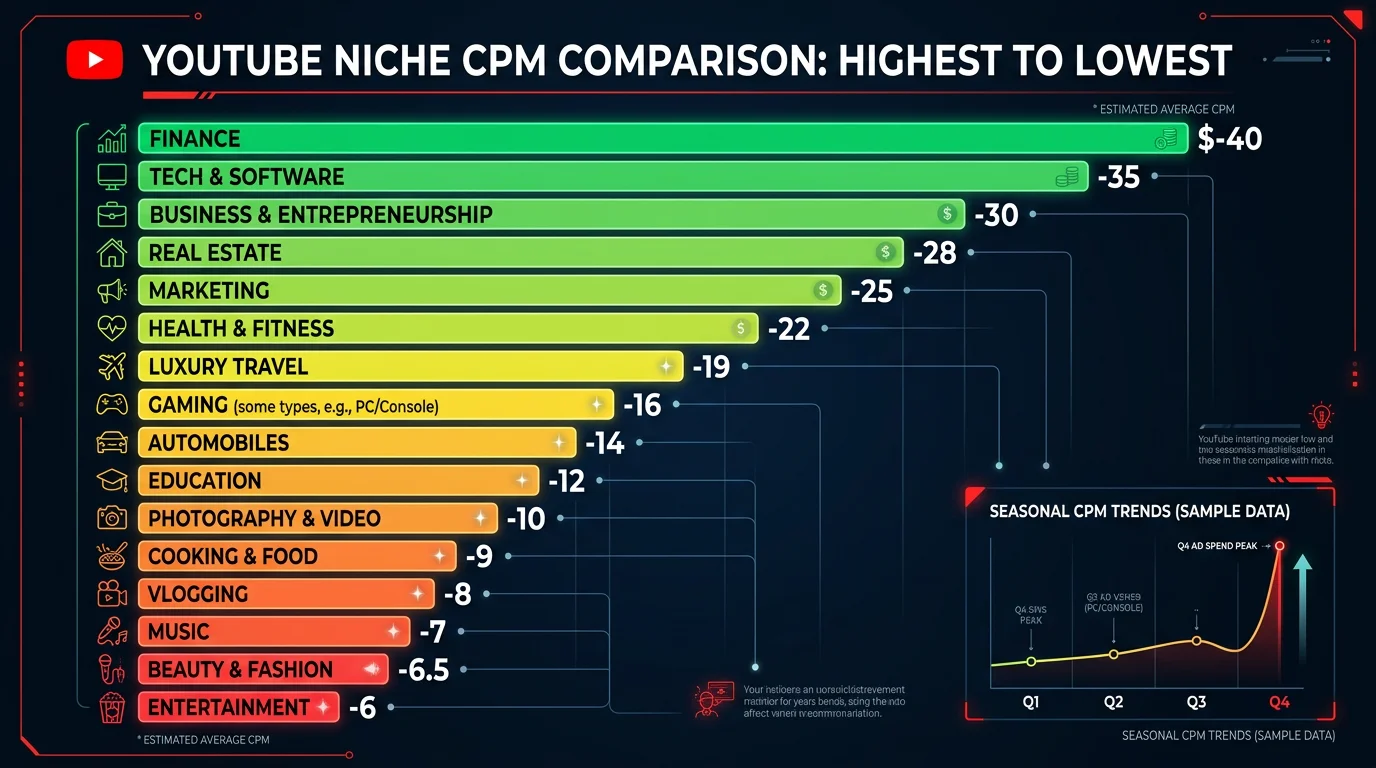
Your YouTube earnings depend less on how many subscribers you have and more on one number most creators never check: CPM. Cost per mille (the price advertisers pay per 1,000 ad impressions on your videos) varies wildly depending on the niche you create in. A finance channel and a gaming channel with identical view counts can have a 5x difference in monthly revenue, and CPM is the reason why.
This guide breaks down CPM rates across 15 popular YouTube niches for 2026, explains how CPM translates into the money you actually take home, and shows you what levers you can pull to push your rates higher. If you''re building a channel with monetization in mind, start with our full YouTube monetization guide for the big picture, then use this page as your niche-level reference.
What Is YouTube CPM?
CPM stands for cost per mille — the amount an advertiser pays YouTube for every 1,000 ad impressions served on your videos. If an advertiser''s CPM is $12, they pay YouTube $12 each time their ad is shown 1,000 times on your content.
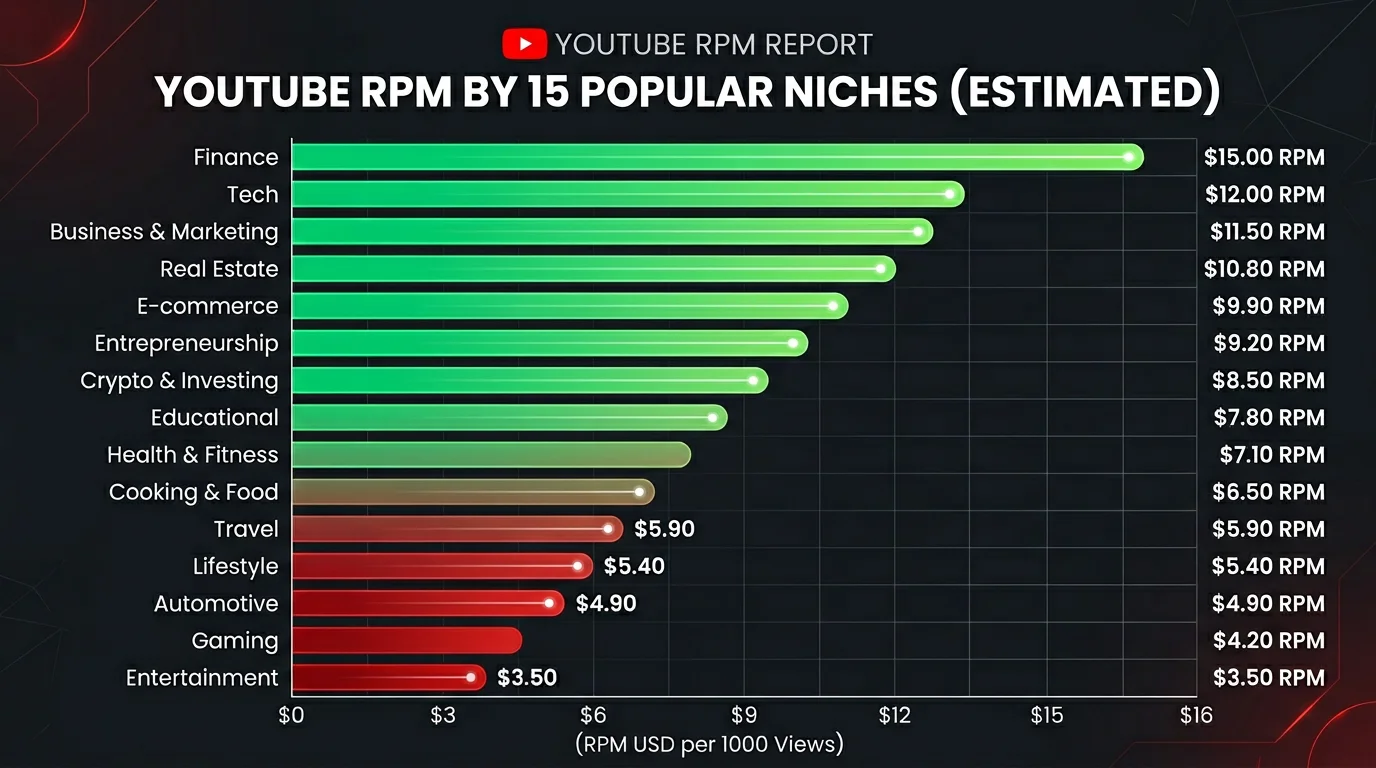
But CPM is not what you earn. YouTube takes a 45% cut of ad revenue, and not every view triggers an ad. The metric that reflects your actual earnings is RPM (Revenue Per Mille) — your total revenue divided by every 1,000 views, including views that didn''t show an ad at all.
Here''s the simple relationship:
- CPM = what advertisers pay (per 1,000 ad impressions)
- RPM = what you earn (per 1,000 total views)
- Typical RPM = roughly 40–60% of CPM, depending on your ad fill rate
You can track both numbers inside YouTube Analytics under the Revenue tab. Understanding this distinction matters because a high CPM niche with low ad fill can sometimes pay less than a moderate CPM niche where every view is monetized.
YouTube CPM by Niche — 2026
The table below reflects estimated CPM ranges for U.S.-based audiences in 2026. Rates outside the United States are typically 40–70% lower. Within each range, your exact CPM depends on audience demographics, watch time, content format, and seasonality.
| Niche | CPM Range (USD) | Avg RPM (USD) | Why This Rate |
|---|---|---|---|
| Finance & Investing | $15 – $40 | $8 – $20 | Banks, brokerages, and fintech companies bid aggressively for high-intent viewers researching money topics. |
| Real Estate | $12 – $30 | $6 – $15 | Mortgage lenders and property platforms pay premium rates for audiences actively looking to buy or invest. |
| Technology | $10 – $30 | $5 – $14 | SaaS companies, cloud providers, and electronics brands compete heavily for tech-savvy viewers. |
| Business & Entrepreneurship | $10 – $25 | $5 – $12 | B2B software, business tools, and course creators target this audience with high-value offers. |
| Education | $8 – $20 | $4 – $10 | EdTech platforms and online course providers see strong ROI advertising to learners. |
| Health & Fitness | $6 – $18 | $3 – $9 | Supplement brands, fitness apps, and health insurers value engaged wellness audiences. |
| Travel | $5 – $18 | $3 – $9 | Airlines, hotels, and booking platforms pay well, especially for destination-specific content. |
| Psychology | $5 – $15 | $3 – $8 | Therapy platforms, self-help apps, and wellness brands target viewers interested in mental health. |
| Stoicism & Philosophy | $5 – $14 | $2.50 – $7 | Book publishers, journaling apps, and personal development brands find a focused, educated audience. |
| Beauty & Skincare | $4 – $14 | $2 – $7 | Cosmetic brands spend heavily on influencer-adjacent content, though competition keeps CPM variable. |
| Motivation | $4 – $12 | $2 – $6 | Broad audience appeal but lower commercial intent makes advertiser bids moderate. |
| Food & Cooking | $4 – $12 | $2 – $6 | Grocery delivery, kitchen appliance, and meal kit advertisers compete in a large but general market. |
| Horror & True Crime | $3 – $10 | $1.50 – $5 | Some advertisers avoid controversial content, reducing bid competition despite high view counts. |
| Gaming | $2 – $8 | $1 – $4 | Massive supply of gaming content dilutes ad rates. Younger demographics also lower advertiser bids. |
| Entertainment & Vlogs | $2 – $6 | $1 – $3 | Broad, unspecific audiences make it hard for advertisers to target, so bids stay low. |
A few patterns stand out. Niches where the viewer is close to making a purchase decision (finance, real estate, tech) command the highest CPMs. Niches with younger audiences or very broad topics (gaming, entertainment) sit at the bottom. For a deeper look at how these CPM rates translate into actual channel revenue, see our YouTube ad revenue by niche breakdown.
Long-Form CPM vs YouTube Shorts CPM
If you''re creating YouTube Shorts, your CPM picture looks very different. Shorts monetization runs through the YouTube Partner Program''s Shorts revenue sharing, which pools ad revenue from the Shorts feed and distributes it based on your share of total Shorts views.
In practice, Shorts CPM tends to land between $0.04 and $0.15 per 1,000 views — a fraction of long-form rates. Here''s how they compare across a few niches:
Create Faceless Videos on Autopilot
FlowShorts generates and posts AI videos to YouTube, TikTok & Instagram while you sleep.
Try FlowShorts Free →| Niche | Long-Form CPM | Shorts CPM | Difference |
|---|---|---|---|
| Finance | $15 – $40 | $0.08 – $0.15 | ~150–300x lower |
| Tech | $10 – $30 | $0.06 – $0.12 | ~150–250x lower |
| Gaming | $2 – $8 | $0.04 – $0.08 | ~50–100x lower |
| Entertainment | $2 – $6 | $0.03 – $0.06 | ~50–100x lower |
That gap is significant. A finance Shorts video with 1 million views might earn $80–$150, while a 10-minute long-form finance video with 100,000 views could earn $800–$2,000. The math favors long-form on pure CPM, but Shorts can still be valuable for audience building and driving viewers to your longer content. For a full breakdown of Shorts earnings, read how much YouTube pays for Shorts.
Seasonal CPM Changes
YouTube CPM is not static throughout the year. Advertiser budgets follow predictable cycles, and understanding them helps you plan your content calendar around peak earning periods.
| Quarter | CPM Trend | Why |
|---|---|---|
| Q1 (Jan – Mar) | Lowest (–15% to –25%) | Advertisers reset budgets after holiday spending. January is typically the weakest month of the year. |
| Q2 (Apr – Jun) | Moderate (baseline) | Budgets normalize. Back-to-school planning begins late in the quarter. |
| Q3 (Jul – Sep) | Rising (+10% to +15%) | Back-to-school campaigns, summer travel advertising, and early holiday planning ramp up spend. |
| Q4 (Oct – Dec) | Peak (+30% to +50%) | Black Friday, Cyber Monday, and holiday shopping drive the biggest ad budgets of the year. November and December CPMs can spike dramatically. |
In high-CPM niches like finance, the Q4 spike can be even more dramatic — CPMs above $50 have been reported during the last two weeks of December. If you publish evergreen content, consider scheduling your most valuable uploads for October through December to capture peak rates.
5 Ways to Increase Your YouTube CPM
While niche selection sets your CPM baseline, several factors within your control can push rates higher.
1. Target High-Value Demographics
Advertisers pay more to reach viewers aged 25–54 with higher household income. Content that attracts professionals, business owners, or people actively researching purchases will command better CPMs than content skewing toward teenagers.
2. Create Longer Videos With Multiple Ad Breaks
Videos over 8 minutes can include mid-roll ads, which significantly increases your ad impressions per view. A 15-minute video with three ad placements earns more per viewer than a 5-minute video with a single pre-roll, even at the same CPM.
3. Focus on U.S. and Tier-1 Audiences
CPM rates in the United States, Canada, United Kingdom, Australia, and Northern Europe are 3–10x higher than in South Asia, Southeast Asia, or Africa. If your content naturally attracts a global audience, consider creating supplementary content that specifically targets English-speaking markets.
4. Improve Audience Retention
Create Faceless Videos on Autopilot
FlowShorts generates and posts AI videos to YouTube, TikTok & Instagram while you sleep.
Try FlowShorts Free →YouTube''s algorithm favors videos with high watch time. Longer average view duration means more mid-roll ad opportunities and signals to YouTube that your content is high quality, which can improve your ad fill rate. Check your retention curves in YouTube Analytics to identify where viewers drop off.
5. Stay Advertiser-Friendly
Videos flagged with limited or no ads due to content guidelines will tank your effective CPM regardless of niche. Avoid excessive profanity, controversial topics, and graphic content. Channels with a clean track record tend to receive higher-paying brand-safe advertisements.
Frequently Asked Questions
What is a good YouTube CPM?
A "good" CPM depends entirely on your niche. In entertainment or gaming, $4–$6 is solid. In finance or tech, anything below $10 would be considered low. As a general benchmark, a CPM above $8 across all niches puts you in a healthy range for U.S. audiences.
Why is my YouTube CPM so low?
The most common reasons are: your audience is primarily outside Tier-1 countries, your niche has low advertiser demand, your videos are flagged as limited ads, or you''re checking during Q1 when rates naturally dip. Review your audience geography in YouTube Analytics — if more than 50% of views come from low-CPM regions, that explains most of the gap. You can also check if you meet all the requirements in the YouTube Partner Program.
Does YouTube CPM change by country?
Significantly. U.S. CPMs are the global benchmark. Canadian and UK CPMs typically run 70–90% of U.S. rates. German and Australian CPMs are comparable. Indian CPMs average $1–$3, and Southeast Asian CPMs often fall below $1. Your channel''s effective CPM is a weighted average based on where your viewers are located.
Is Shorts CPM worth it compared to long-form?
Not for direct ad revenue — Shorts CPMs are roughly 100–200x lower than long-form. However, Shorts serve a different strategic purpose. They drive discovery, grow your subscriber base, and funnel viewers toward your long-form content where the real CPM money is. The best strategy is using both formats together.
Making CPM Work For You
CPM sets the ceiling on your YouTube earnings potential, but it''s not the only factor. Diversifying into sponsorships, affiliate marketing, and digital products often matters more than chasing the highest-CPM niche. A creator in a $4 CPM niche with strong sponsorship deals can easily out-earn someone in a $30 CPM niche relying purely on AdSense.
Use the YouTube Money Calculator to estimate your potential earnings based on your niche''s CPM range. For a comprehensive look at how ad revenue varies across categories, read our YouTube ad revenue by niche guide. And if you''re ready to start publishing consistently, FlowShorts can help you automate your short-form video creation so you can focus on the content strategy that drives real revenue.
For the latest updates from YouTube on monetization policies and creator tools, keep an eye on the official YouTube Creator blog.