YouTube Ad Revenue: How Much Creators Earn by Niche (2026)
YouTube ad revenue broken down by 15 niches with RPM data, CPM ranges, and monthly earnings estimates. See how much creators actually earn from ads in finance, tech, gaming, beauty, and 11 more niches in 2026.
FlowShorts Team
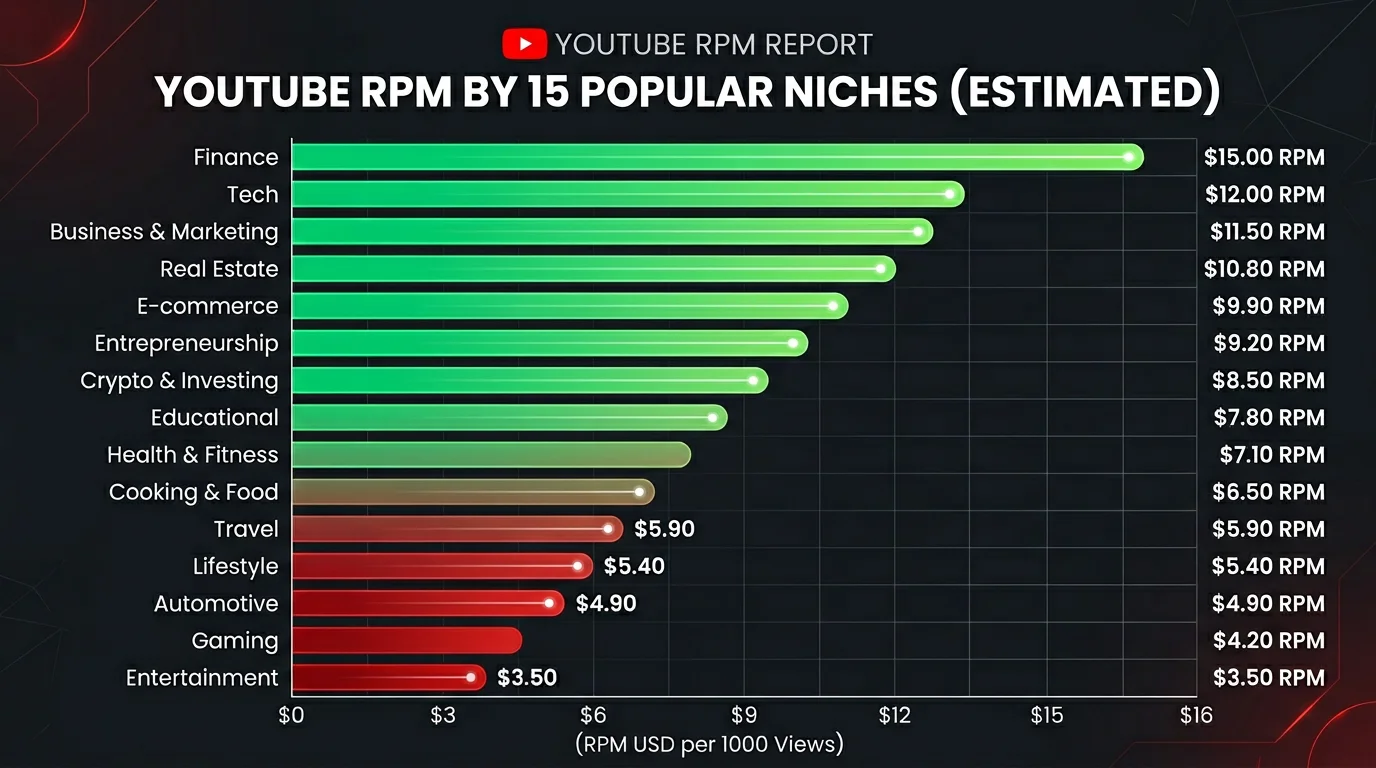
"How much do YouTubers make?" is one of the most frequently searched questions about online careers. The honest answer is that it depends almost entirely on your niche. A finance channel with 100,000 monthly views can earn five times more than a gaming channel with the same view count. The difference comes down to advertiser demand, audience purchasing power, and the cost brands are willing to pay to reach specific viewers.
This guide breaks down YouTube ad revenue across 15 popular niches using 2026 data. You will see exactly how CPM and RPM vary by topic, what realistic monthly earnings look like at different subscriber levels, and how to position your channel for higher payouts.
How YouTube Ad Revenue Works (CPM vs RPM)
Before looking at the numbers, you need to understand two metrics that determine your paycheck.
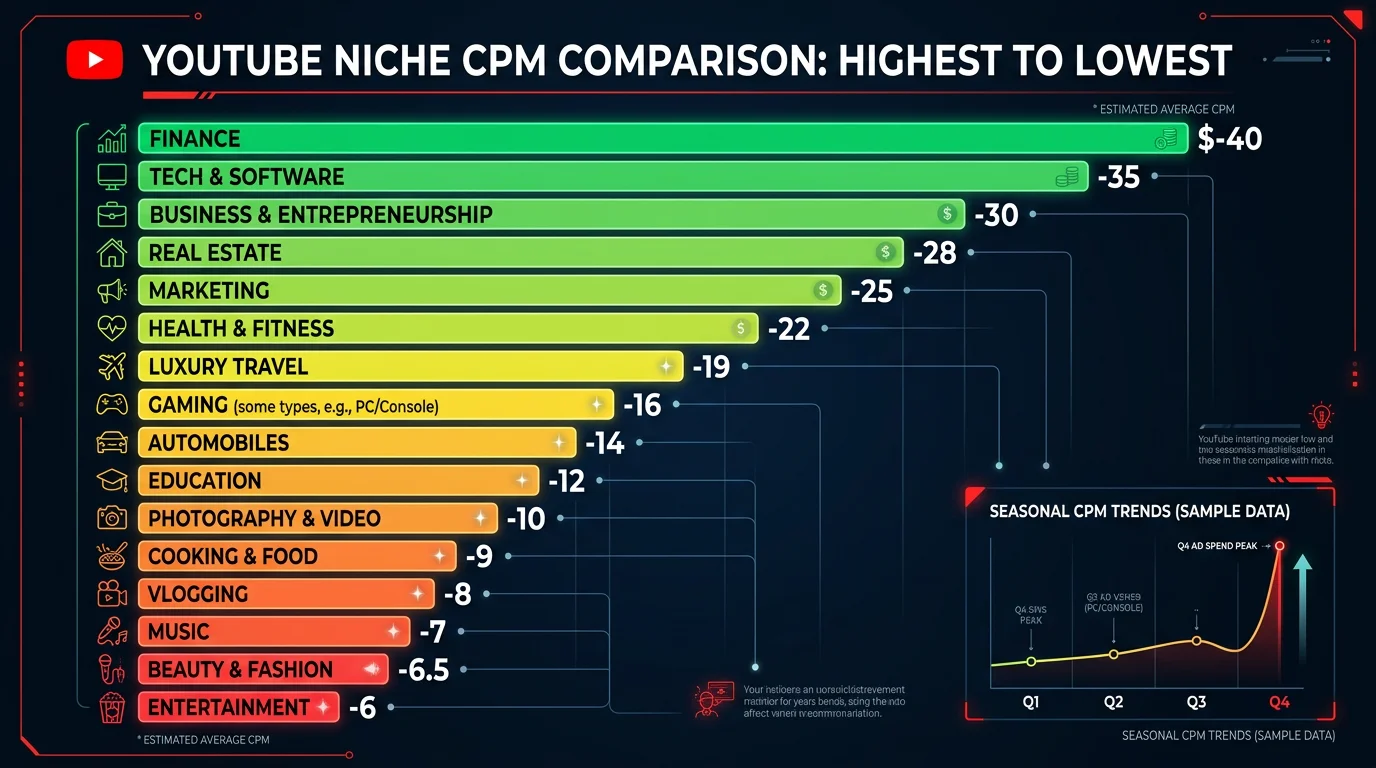
CPM (Cost Per Mille) is what advertisers pay YouTube for 1,000 ad impressions on your videos. This is the gross number before YouTube takes its cut. CPM reflects advertiser demand for your audience.
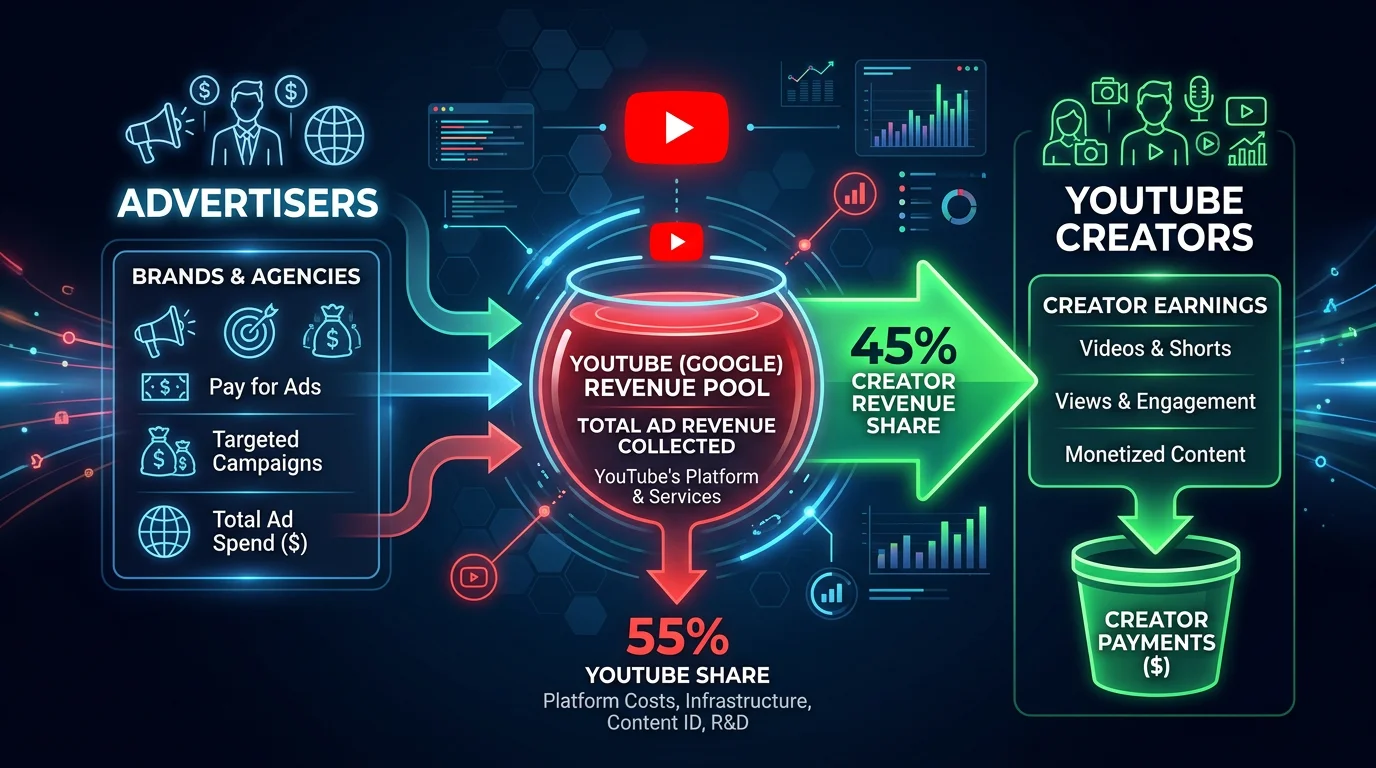
RPM (Revenue Per Mille) is what you actually earn per 1,000 views after YouTube takes its 45% share and after accounting for views where no ad was served. RPM is always lower than CPM because not every view generates an ad impression. RPM is your real earnings metric.
For example, if your CPM is $10 and your RPM is $5, that means YouTube kept its share and roughly half your views did not show an ad. Your bank account only cares about RPM.
To join the YouTube Partner Program and start earning ad revenue, you need 1,000 subscribers and either 4,000 watch hours (long-form) or 10 million Shorts views in the past 90 days. Once accepted, ads run on your content automatically. You can track your earnings through YouTube Analytics in the Revenue tab.
YouTube Ad Revenue by Niche — 2026 Data
The table below shows estimated CPM ranges, RPM ranges, and projected monthly earnings at 100,000 views for 15 of the most popular YouTube niches. These figures are based on aggregated creator reports, ad industry benchmarks, and platform data from early 2026.
| Niche | CPM Range | RPM Range | Est. Monthly Earnings (100K Views) |
|---|---|---|---|
| Finance & Investing | $15 - $35 | $8 - $15 | $800 - $1,500 |
| Real Estate | $12 - $30 | $6 - $12 | $600 - $1,200 |
| Technology | $10 - $28 | $5 - $12 | $500 - $1,200 |
| Business & Entrepreneurship | $10 - $25 | $5 - $10 | $500 - $1,000 |
| Education | $8 - $20 | $4 - $8 | $400 - $800 |
| Travel | $6 - $18 | $3 - $8 | $300 - $800 |
| Health & Fitness | $6 - $16 | $3 - $7 | $300 - $700 |
| Psychology | $6 - $14 | $3 - $6 | $300 - $600 |
| Stoicism & Philosophy | $6 - $14 | $3 - $6 | $300 - $600 |
| Beauty & Skincare | $4 - $14 | $2 - $6 | $200 - $600 |
| Motivation | $4 - $12 | $2 - $5 | $200 - $500 |
| Food & Cooking | $4 - $12 | $2 - $5 | $200 - $500 |
| Horror & Mystery | $4 - $10 | $2 - $4 | $200 - $400 |
| Gaming | $2 - $8 | $1 - $4 | $100 - $400 |
| Entertainment & Comedy | $2 - $7 | $1 - $3 | $100 - $300 |
These numbers assume a U.S.-majority audience. If your viewers are primarily in Southeast Asia, Latin America, or Africa, expect RPMs 60-80% lower. Geography is one of the biggest factors in ad revenue after niche selection.
Use the YouTube Money Calculator to estimate earnings based on your specific view count and niche.
Why Finance Pays 5x More Than Gaming
The gap between top-paying and bottom-paying niches is not random. It follows a clear economic logic based on three factors.
Advertiser willingness to pay. Financial services companies (banks, investment platforms, insurance providers, credit card companies) have enormous customer lifetime values. A single new banking customer might be worth $2,000 or more over their lifetime. These companies can afford to pay $30 CPM because converting even a tiny fraction of viewers produces a massive return. Gaming advertisers, by contrast, are often promoting $5-$15 mobile games or free-to-play titles with much smaller margins.
Audience purchasing power. Finance viewers are typically adults with disposable income who are actively looking for ways to invest or manage money. They are in a buying mindset. Entertainment and gaming audiences skew younger, with less spending power and lower intent to purchase.
Ad inventory competition. There are fewer finance channels relative to the number of financial advertisers competing for that audience. Gaming and entertainment have massive content supply but comparatively fewer high-CPM advertisers fighting for those placements. Basic supply and demand drives prices down.
Create Faceless Videos on Autopilot
FlowShorts generates and posts AI videos to YouTube, TikTok & Instagram while you sleep.
Try FlowShorts Free →This does not mean you should avoid low-RPM niches. Gaming channels compensate with volume. A gaming channel might get 10 million views per month while a finance channel struggles to hit 500,000. Total revenue can be similar even with dramatically different RPMs.
YouTube Shorts Ad Revenue vs Long-Form
If you are creating short-form content, the revenue picture changes significantly. YouTube Shorts RPM is substantially lower than long-form video RPM across every niche.
| Format | Average RPM Range | Revenue per 1M Views |
|---|---|---|
| Long-form (8+ min) | $3 - $12 | $3,000 - $12,000 |
| YouTube Shorts | $0.03 - $0.08 | $30 - $80 |
Shorts RPM is roughly 50-100x lower than long-form RPM. The reason is structural: Shorts ads are shared across a pool of creators in the Shorts feed, and the viewing sessions are shorter, which means fewer ad opportunities per session.
However, Shorts serve a different strategic purpose. They drive subscriber growth far faster than long-form content. Many creators use Shorts as a discovery engine to build their audience, then monetize that audience through long-form videos, sponsorships, and products. For a deeper look at Shorts monetization, read our guide on how much YouTube pays for Shorts.
How to Increase Your YouTube Ad Revenue
Regardless of your niche, there are concrete steps to push your RPM higher.
1. Target high-CPM countries. Create content in English and optimize for viewers in the United States, United Kingdom, Canada, Australia, and Germany. These countries have the highest advertiser spending. Use English titles, descriptions, and tags even if you speak multiple languages.
2. Make videos longer than 8 minutes. Videos over 8 minutes can run mid-roll ads, which dramatically increases the number of ad impressions per view. A 15-minute video might show 3-4 ads compared to a single pre-roll on a 5-minute video. This alone can double your RPM.
3. Increase watch time and session duration. YouTube serves more ads to viewers who watch longer. If your average view duration is 60% of video length versus 30%, you will earn more per view because YouTube has more opportunities to insert ads. Focus on retention: strong hooks, clear structure, and no unnecessary padding.
4. Enable all ad formats. In YouTube Studio, make sure you have enabled pre-roll ads, mid-roll ads (for 8+ minute videos), post-roll ads, and overlay ads. Some creators disable certain formats to improve viewer experience, but each format you turn off reduces your revenue ceiling.
5. Publish consistently during high-CPM periods. Advertiser spending peaks in Q4 (October through December) because of holiday shopping. January sees the sharpest drop. Understanding this cycle helps you plan content releases for maximum revenue. Publish your best, highest-effort content in Q4 when CPMs can spike 40-60% above the annual average.
Getting monetized on YouTube is the first milestone. After that, these optimizations compound over time to meaningfully increase your earnings.
Realistic Earnings Timeline
One of the biggest misconceptions about YouTube is that large subscriber counts automatically mean large paychecks. The reality is more nuanced. Views matter more than subscribers, and niche determines the value of each view.
The table below shows estimated monthly ad revenue at different subscriber milestones, assuming average engagement rates and a mid-range RPM of $4 (which represents a blend across niches).
Create Faceless Videos on Autopilot
FlowShorts generates and posts AI videos to YouTube, TikTok & Instagram while you sleep.
Try FlowShorts Free →| Subscriber Count | Est. Monthly Views | Est. Monthly Ad Revenue | Notes |
|---|---|---|---|
| 1,000 | 5,000 - 15,000 | $20 - $60 | Just monetized, building momentum |
| 5,000 | 20,000 - 60,000 | $80 - $240 | Consistent uploads starting to pay off |
| 10,000 | 40,000 - 120,000 | $160 - $480 | Side income territory |
| 50,000 | 150,000 - 500,000 | $600 - $2,000 | Part-time income, sponsors start reaching out |
| 100,000 | 300,000 - 1,000,000 | $1,200 - $4,000 | Full-time viable in many markets |
| 500,000 | 1,500,000 - 5,000,000 | $6,000 - $20,000 | Strong full-time income |
| 1,000,000 | 3,000,000 - 10,000,000 | $12,000 - $40,000 | Top-tier creator level |
Remember that these are ad revenue estimates only. Most successful creators earn 2-5x their ad revenue from sponsorships, affiliate marketing, courses, and merchandise. Ad revenue is the baseline, not the ceiling.
Faceless channels, which use stock footage, AI-generated visuals, or screen recordings instead of on-camera talent, follow the same revenue structure. For specifics on that model, see our breakdown of faceless YouTube channel income.
Frequently Asked Questions
How much does YouTube pay per 1,000 views?
YouTube pays creators between $1 and $15 per 1,000 views depending on the niche, audience location, and time of year. The average across all niches and geographies is roughly $3 to $5 per 1,000 views (RPM). Finance and tech channels sit at the high end, while gaming and entertainment channels are at the low end.
How much does YouTube pay for 1 million views?
At an average RPM of $4, one million views generates approximately $4,000 in ad revenue. However, this varies widely. A finance channel could earn $8,000 to $15,000 for one million views, while an entertainment channel might earn $1,000 to $3,000 for the same view count. Use the YouTube Money Calculator for a personalized estimate.
Do YouTube Shorts pay ad revenue?
Yes, YouTube Shorts are monetized through the Shorts ad revenue sharing program. Creators in the YouTube Partner Program earn a share of ad revenue from ads displayed between Shorts in the feed. However, Shorts RPM is significantly lower than long-form RPM, typically between $0.03 and $0.08 per 1,000 views. Read our full guide on YouTube Shorts pay rates for details.
How do I check my RPM on YouTube?
Go to YouTube Studio, click Analytics in the left menu, then select the Revenue tab. You will see your RPM displayed alongside your CPM, estimated revenue, and other monetization metrics. You can filter by date range and by individual video to see which content earns the most per view. Our YouTube Analytics guide walks through every metric in detail.
Can faceless channels earn YouTube ad revenue?
Yes. Faceless channels earn ad revenue through the same YouTube Partner Program as any other channel. YouTube does not differentiate between faceless and on-camera content for monetization purposes. As long as the content is original, provides value, and meets community guidelines, it qualifies for full ad revenue. Many faceless channels in niches like finance, motivation, and history earn strong RPMs because their content targets high-value audiences. Learn more about the earning potential of faceless channels.
What This Means for Your Channel Strategy
YouTube ad revenue is real money, but it rewards strategic thinking over raw effort. Choosing a high-RPM niche, targeting English-speaking audiences, creating longer videos, and publishing consistently during peak advertiser periods can multiply your earnings by 3-5x compared to a creator who ignores these factors.
The most important takeaway from this data: niche selection is the single highest-leverage decision you make as a creator. It determines your RPM floor and ceiling before you upload a single video. If you are starting a new channel or considering a pivot, weigh the revenue potential alongside your interest and expertise in the topic.
For a complete walkthrough of every way YouTube pays creators, including ad revenue, Shorts, Super Chats, memberships, and the creator fund, read our full YouTube monetization guide.
For creator stories and official updates on the partner program, check the YouTube Creator Blog.